

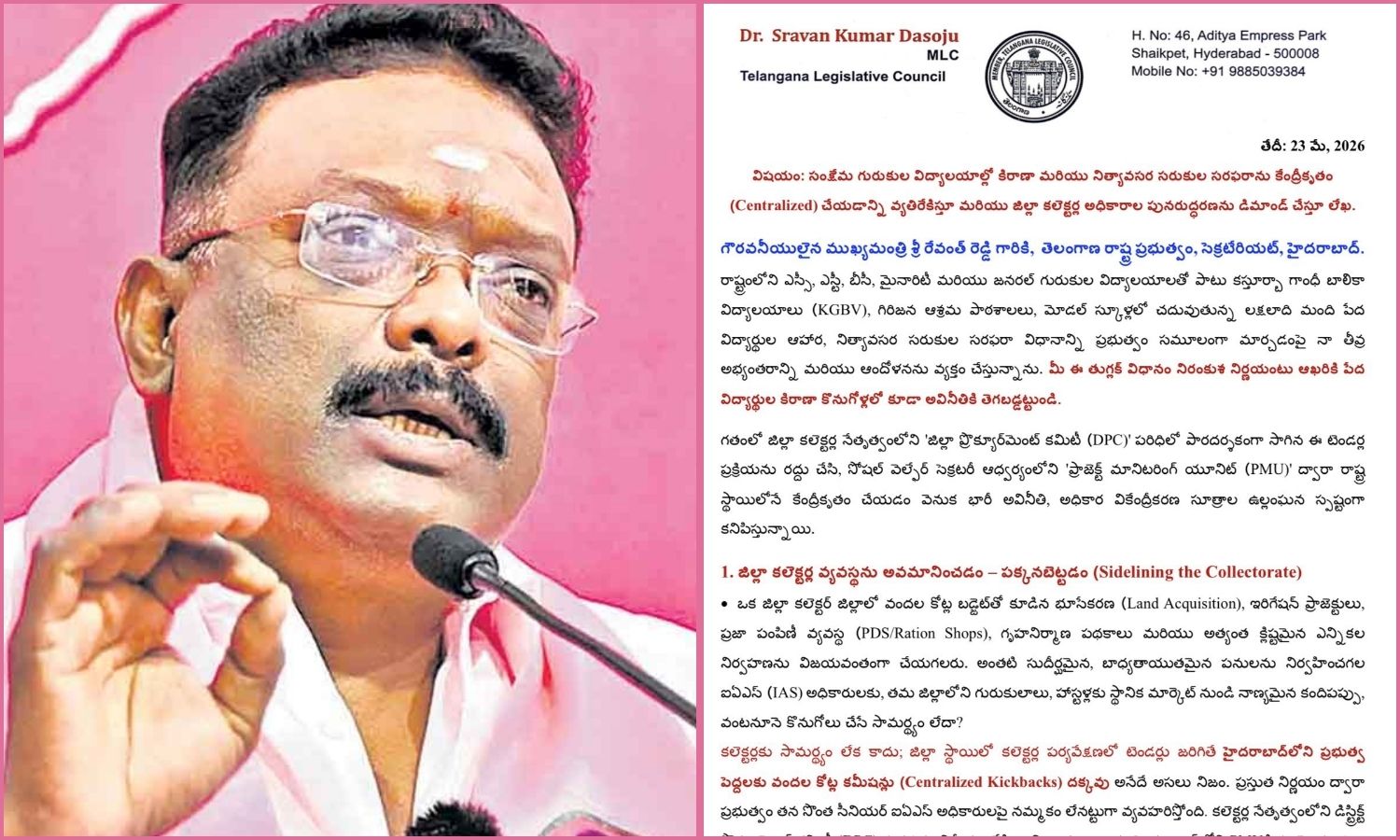
Hyderabad: BRS senior leader and MLC Professor Dasoju Sravan alleged a ₹500 crore scam in centralized residential school grocery tenders for welfare hostels and schools in Telangana.
In an open letter addressed to Chief Minister A. Revanth Reddy and the Chief Secretary, Dasoju Sravan accused the government of introducing centralized procurement to facilitate commissions worth nearly ₹100 crore. He alleged that the tenders covered groceries and essential commodities supplied to students studying in SC, ST, BC, Minority and General Welfare residential institutions.
The BRS leader questioned the decision to remove procurement powers from district collectors. According to him, district collectors regularly handled major responsibilities including land acquisition, irrigation projects, ration distribution and elections.
He argued that the government weakened District Procurement Committees to centralise contracts and control commissions. Meanwhile, he alleged that the system favoured ruling party leaders and private contractors.
Dasoju Sravan also criticised the government over the exclusion of Tandur red gram from hostel meals. He claimed authorities planned to replace locally grown pulses with cheaper imported stock from African countries.
Residential school grocery tenders trigger corruption allegations
The MLC alleged that the government ignored the three-month tender system followed by the Telangana State Food Corporation. According to him, quarterly tenders ensured fresh supplies and allowed the government to benefit from changing market prices.
However, he questioned the decision to finalise tenders for one year despite fluctuations in commodity prices. In his view, the policy would force the government to continue purchases at inflated rates even if prices declined later.
Dasoju Sravan also opposed the ₹165 crore turnover condition included in the tender process. He said the clause would block small traders and women self-help groups from participating in residential school grocery tenders.
Instead, he suggested that the government should use MARKFED to procure pulses directly from local farmers at Minimum Support Price. He also proposed involving women self-help groups in packaging and distribution activities.
According to him, the cooperative model would support farmers, generate rural employment and reduce costs. At the same time, he alleged that the present policy encouraged corporate favouritism instead of student welfare.
The BRS leader also referred to pending High Court cases linked to centralized procurement of bunker beds and student uniforms. Further, he questioned the government’s decision to involve the same Project Monitoring Unit in grocery procurement.
Dasoju Sravan warned that political leaders and officials involved in the process would face judicial inquiry under a future BRS government led by K. Chandrashekar Rao. He demanded immediate cancellation of the centralized residential school grocery tenders and restoration of district-level procurement systems.
*గురుకులాల కిరాణా టెండర్లలో రూ. 500 కోట్ల భారీ కుంభకోణానికి కుట్ర: రేవంత్ రెడ్డి ప్రభుత్వ తుగ్లక్ నిర్ణయంపై మండిపడ్డ బీఆర్ఎస్ సీనియర్ నేత, ఎమ్మెల్సీ ప్రొఫెసర్ దాసోజు శ్రవణ్**
🚨 రూ. 100 కోట్ల ‘కేంద్రీకృత కమీషన్ల’ కోసమే జిల్లా కలెక్టర్ల అధికారాలకు కత్తెర!**
🌾 తెలంగాణ బ్రాండ్… pic.twitter.com/ORRY01CmCu— Prof Dasoju Sravan Kumar (@sravandasoju) May 23, 2026