
Vivek Venkatswamy calls for industry-focused skill training to boost Telangana’s growth

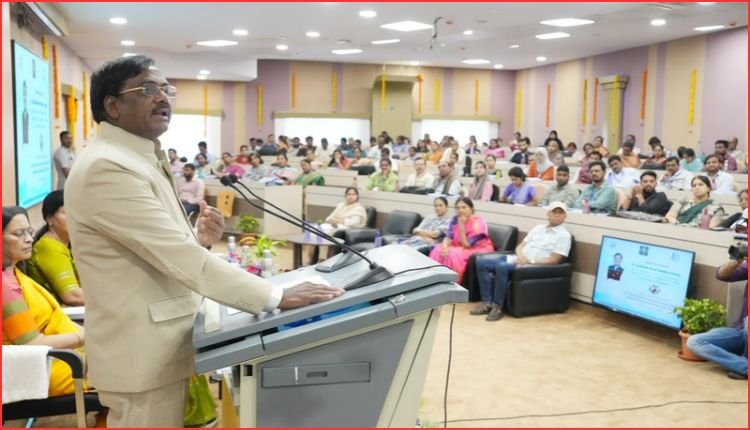
Hyderabad: Telangana Labour, Employment, Training, Mines and Geology Minister Gaddam Vivek Venkatswamy called for industry-focused skill training to bridge the gap between educational qualifications and employment requirements. He said closer cooperation between industries and educational institutions was essential for economic growth and job creation.
The minister said India must achieve 8% annual economic growth to become a $5 trillion economy by 2047. He also linked the growth target to Telangana’s ambition of becoming a $3 trillion economy.
However, he stressed that economic expansion must receive equal emphasis alongside environmental protection and sustainable development. Vivek Venkatswamy addressed the concluding session of a two-day national conference on economic growth, sustainable development and public policy.
The Dr Marri Channa Reddy Human Resource Development Institute organised the conference as part of its golden jubilee celebrations.
Industry-focused skill training needed to bridge employment gap
The minister said human resource development played a crucial role in sustaining economic growth. He pointed to a mismatch between the skills acquired by students and the competencies required by industries.
According to Vivek Venkatswamy, educational institutions should move beyond their existing courses and training programmes. Instead, they should identify the actual requirements of employers and equip students with relevant technical and practical skills.
He called for stronger partnerships between industries and academic institutions to improve employment opportunities. The minister emphasised that training programmes should respond to changing industrial requirements rather than remain limited to conventional academic instruction.
He also stressed the importance of practical knowledge and technical competence in preparing young people for employment. Vivek Venkatswamy outlined the state government’s efforts to modernise vocational training infrastructure.
He said Telangana was upgrading 65 Industrial Training Institutes (ITIs) into Advanced Training Centres. Additionally, the government had prepared plans to establish another 54 advanced training centres.
The minister stated that the government’s target was to make 122 advanced training centres available by next year. He said these facilities would provide modern technical training aligned with industrial requirements.
The initiative aimed to improve employment prospects by preparing young people for jobs requiring specialised technical skills. Vivek Venkatswamy maintained that industry-oriented vocational education would strengthen the state’s skilled workforce.
He also highlighted the need to ensure that training programmes remained relevant to technological changes and emerging employment opportunities. The minister urged young people to explore international employment opportunities amid growing global demand for skilled workers.
Referring to his recent visits to Japan and Germany, he said both countries faced substantial workforce shortages. He observed that lakhs of jobs remained vacant annually because of inadequate workforce availability and ageing populations.
Vivek Venkatswamy described these conditions as an opportunity for Indian youth seeking employment overseas. However, he said applicants must acquire the technical skills, qualifications and competencies required by employers in those countries.
The minister also highlighted the adaptability of Indian workers in different social and professional environments. He said Indians generally demonstrated an ability to integrate into foreign societies, adjust to changing circumstances and work diligently.
According to him, combining these qualities with appropriate professional skills could improve their competitiveness in international employment markets. He encouraged young people to prepare for overseas opportunities by understanding country-specific workforce requirements.
Telangana Rising investments must generate employment
Vivek Venkatswamy also discussed Telangana’s investment prospects and the importance of converting industrial commitments into employment opportunities. He said the Telangana Rising Global Summit held last year had attracted investments worth ₹5.74 lakh crore.
The minister stressed that skilled human resources would play a decisive role in translating these investments into industrial expansion. He said the state needed a workforce capable of supporting new industries, increasing economic activity and creating employment opportunities.
Moreover, he emphasised that investment mobilisation alone would not guarantee sustainable economic development. Human resource development, cooperation between industries and educational institutions, and relevant technical training were equally important, he said.
The minister called for coordinated efforts to ensure that industrial investments contributed to employment generation. He also reiterated the need to balance economic growth with environmental sustainability.
National conference draws 200 participants from 12 states
The two-day national conference formed part of the golden jubilee celebrations of the Dr Marri Channa Reddy Human Resource Development Institute. Around 200 research paper presenters, academicians and public policy experts from nearly 12 states participated in the event.
The conference featured discussions and research presentations on economic growth, environmental sustainability, public policy and effective governance. Participants also exchanged experiences and perspectives on development challenges and administrative practices.
The concluding session was attended by MCR HRD Institute Director General Shanti Kumari and Additional Director General Anita Ramachandran. IIT Hyderabad Director Professor B. Murty also attended, along with academicians, researchers and other delegates.
The conference provided a national platform for examining the relationship between economic development, environmental protection, public administration and workforce capabilities.