
Telangana rainfall deficit at 25%, Hyderabad 37% below normal
By Shaik Ahmed Ali

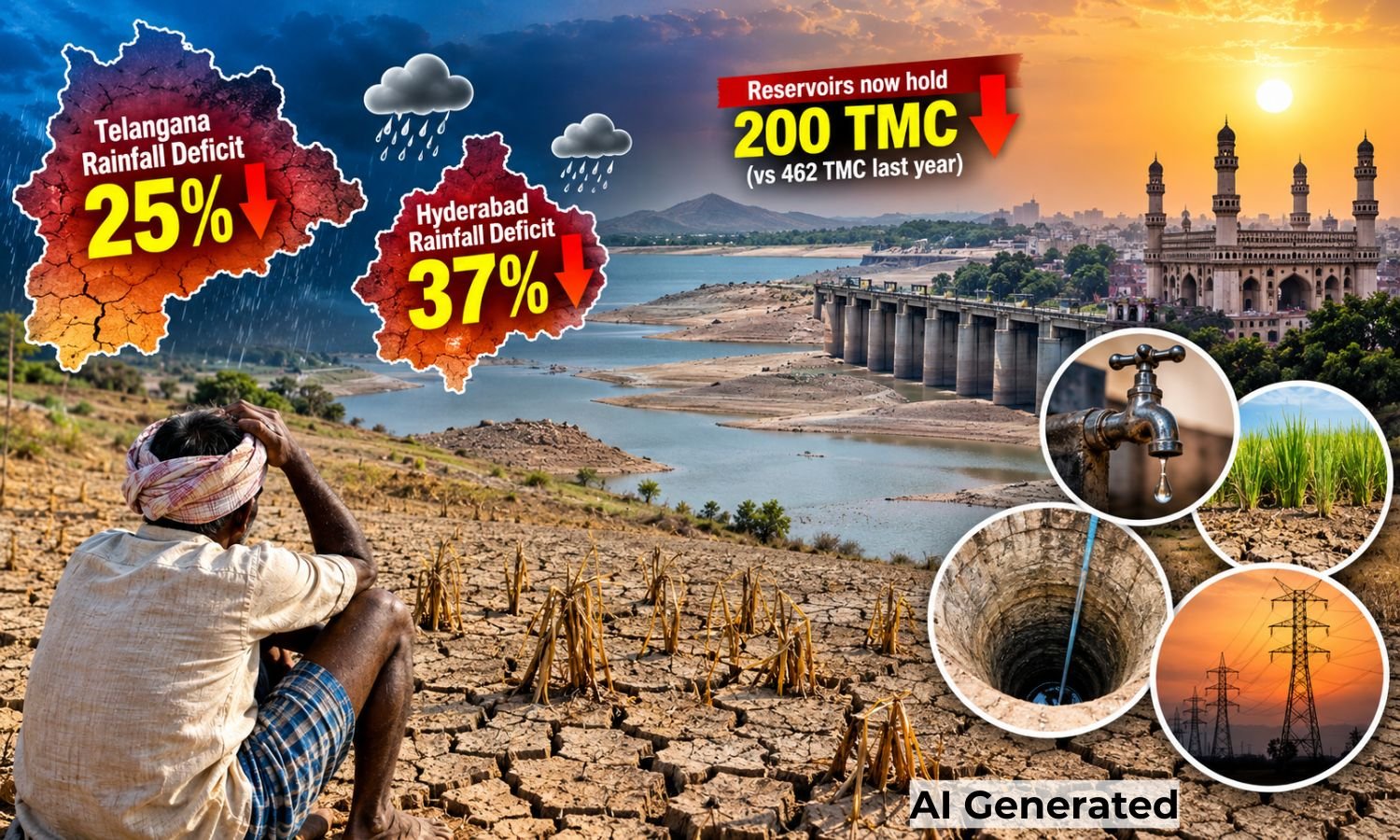
Hyderabad: Not one of Hyderabad’s 16 mandals has received normal rainfall this season, and the Telangana rainfall deficit has widened to 25%. According to the government, reservoirs hold about 200 TMC of water, against around 462 TMC in the corresponding period last year. The State is thus heading into the dry months with sharply reduced water reserves.
Official data up to October 26 shows Telangana received 619 mm of cumulative rainfall since June 1, against the normal 822 mm. Hyderabad district fared worse, with only 458.5 mm against 732.1 mm up to October 25, a shortfall of 37%. Across the State, 22 of 33 districts fall in the deficient category, while only 11 remain normal.
The shortfall raises concerns over drinking water, irrigation, groundwater recharge, agriculture and electricity demand if the dry spell linked to anticipated El Niño conditions persists. The figures also reinforce the government’s warning that water availability could become one of the State’s biggest challenges. Chief Minister A. Revanth Reddy has directed departments to prepare for pressure on these supplies and stressed the need to conserve water. Meanwhile, the government has said the coming eight to 10 months would require careful management of resources.
Telangana rainfall deficit sharpest in southern districts
The shortage is particularly pronounced across parts of southern and central Telangana. Jogulamba Gadwal recorded the State’s highest district-level deficit at 50%, receiving only 269.1 mm against the normal 533.3 mm. Nalgonda and Narayanpet were both 44% below normal, while Medchal-Malkajgiri recorded a 42% deficit.
Nagarkurnool and Hanumakonda were 41% below normal, followed by Wanaparthy at 39%. Mahabubnagar and Warangal were deficient by 38% each, while Hyderabad stood at 37%. Adilabad and Vikarabad recorded deficits of 36%, Khammam 33%, and Bhadradri Kothagudem, Yadadri Bhuvanagiri and Suryapet 32% each. Further, Jangaon was 30% short, Rangareddy 26%, and Nirmal, Mahabubabad and Sangareddy 25% each.
The pattern indicates that the Telangana rainfall deficit is not confined to one climatic or agricultural zone. Instead, it extends from parts of northern Telangana through the Warangal belt to the Hyderabad metropolitan region and across much of the south.
However, some districts remained comparatively better placed. Siddipet was only 2% below normal, Medak 3%, Mancherial 4%, and Kamareddy and Rajanna Sircilla 5% each. Kumuram Bheem, Peddapalli, Jagtial, Karimnagar, Mulugu and Jayashankar also stayed within the normal category.
Every Hyderabad mandal records below-normal rainfall
Hyderabad’s 37% shortfall is 12 percentage points worse than the overall Telangana rainfall deficit. The shortage is also widespread across the city. Charminar and Saidabad recorded the city’s highest deficits at 47% each. Charminar received only 396.1 mm against the normal 750.9 mm, while Saidabad got 384.7 mm against 729.6 mm.
Tirumalgiri was 45% below normal, Nampally 44%, Bandlaguda 43%, Amberpet 41% and Maredpally 40%. Khairatabad recorded a 37% deficit, Asifnagar and Bahadurpura 36% each, and Himayatnagar 33%. Shaikpet and Ameerpet were 32% short, Musheerabad 29%, Golkonda 28% and Secunderabad 27%.
Since every mandal is deficient, the city had no pockets of substantial surplus rainfall to offset dry areas through local recharge. However, the deficit does not mean municipal taps will immediately run dry. A large part of the city’s drinking water comes from major external sources, including the Krishna and Godavari systems. Local rainfall is more directly linked to replenishing lakes, tanks, open wells and groundwater.
As a result, the immediate effect is likely to be weaker recharge of groundwater and local water bodies. The larger threat to piped supply would arise if reservoirs serving Hyderabad also remain inadequate through the summer.
Groundwater and tankers face early strain
Districts adjoining Hyderabad are also under stress. Medchal-Malkajgiri received 407.9 mm against a normal 699.3 mm, while Rangareddy got 475.5 mm against 644.4 mm. Vikarabad was deficient by 36%. Much of the wider metropolitan region is therefore facing below-normal rainfall at the same time.
The impact could be felt in peripheral colonies, gated communities, layouts and fast-urbanising stretches that rely on borewells or private tankers. Poor monsoon recharge can bring an earlier fall in groundwater levels during winter and summer. That could increase borewell failures and dependence on tankers. The effect may become more visible from February, when temperatures rise, evaporation speeds up and household demand grows.
In the city, the earliest warning is likely to come from groundwater rather than the municipal network. Areas relying on individual or community borewells could see yields decline sooner than in a normal year. Apartment complexes and commercial establishments that supplement municipal supply with borewells could also turn increasingly to tankers.
In the Old City, besides Charminar and Saidabad, Bandlaguda was 43% short and Bahadurpura 36%. These figures alone do not determine drinking water availability, but they indicate weak recharge in a densely populated area. Similarly, Tirumalgiri and Maredpally point to poor recharge in parts of Secunderabad, while Nampally suggests stress in central Hyderabad.
Yasangi crop and power demand under pressure
At the State level, agriculture is likely to feel the first major impact. Deficient rainfall reduces soil moisture, groundwater recharge and the water available in minor irrigation tanks. This becomes critical as Telangana moves from the Vanakalam season towards Yasangi. During Yasangi, farmers in several areas depend more heavily on reservoirs, borewells and other assured irrigation sources.
The government has appealed to farmers to reduce water-intensive summer cultivation and conserve water, with drinking water given priority. Reddy said available reservoir storage had fallen sharply compared with the same period last year. He warned that the available water would have to be managed until the next monsoon.
The Telangana rainfall deficit data explains why the government is considering such restrictions. Jogulamba Gadwal, Nalgonda, Narayanpet, Nagarkurnool, Wanaparthy and Mahabubnagar all have substantial agricultural activity. Yet these districts show deficits ranging from 38% to 50%.
Farmers relying on borewells could need longer pumping hours as groundwater levels decline. That, in turn, could raise agricultural electricity demand and create a water-power cycle. Falling groundwater levels require pumps to run for longer periods or from greater depths.
Meanwhile, the government has flagged electricity as a sector likely to face pressure. It said power demand had touched about 20,000 MW, against an average of around 15,000 MW over the previous three years. The government also linked future planning to the expected stress on agriculture and water supplies.
Reservoirs hold far less than last year
The government gave the reservoir figures during its recent review. It said the remaining water would have to be used carefully in the coming months, with drinking water for about 24,000 villages among the priorities. Lower storage and deficient rainfall could therefore have a cumulative effect.
A 25% Telangana rainfall deficit means less inflow into tanks and reservoirs, weaker soil moisture and reduced groundwater recharge. It also means greater dependence on stored water. If winter and pre-monsoon rainfall also stay weak, the pressure could intensify towards March, April and May.
Large-scale water-intensive cultivation in deficient districts could also strain irrigation storage, groundwater and electricity. This would come at a time when the government is trying to preserve water for drinking.
The current pattern contrasts with the previous water year, when Telangana recorded substantially above-normal rainfall. Groundwater Department data for 2025-26 showed excess rainfall, with no district classified as deficient. Consequently, the State cannot assume that last season’s gains will indefinitely cushion the present Telangana rainfall deficit.
Telangana rainfall deficit puts focus on allocation
The Directorate of Economics and Statistics has also recorded the deterioration through October. Its October 25 update placed cumulative State rainfall at 619 mm against the normal 822 mm. The key challenge now is how effectively the remaining water is allocated until the next monsoon.
Agriculture, drinking water, groundwater extraction and electricity are closely linked, and protecting one sector alone could intensify pressure elsewhere. In Hyderabad, the city is unlikely to depend directly on its own rainfall for principal municipal supplies. However, its deficit, combined with shortfalls in Medchal-Malkajgiri and Rangareddy, could lead to a difficult groundwater summer.
In the severely deficient southern districts, decisions over the next few weeks will be key. Choices on Yasangi cultivation, reservoir releases and groundwater use could determine the severity of the water and power situation by next summer. Unless later rainfall partly offsets the Telangana rainfall deficit, conservation and careful allocation are likely to remain central to the State’s El Niño response.