


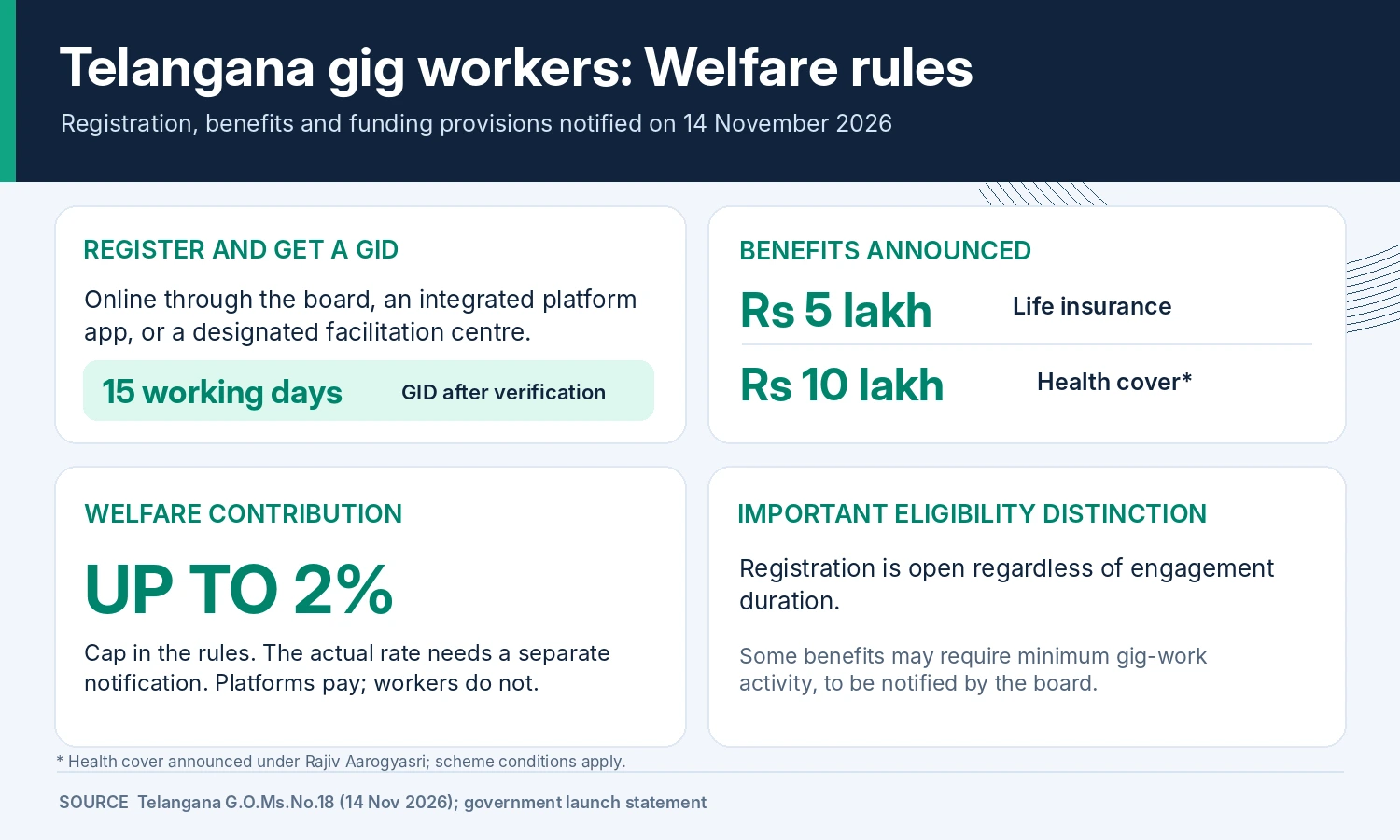
Hyderabad: Telangana gig workers now have final rules governing registration, welfare and working conditions. Chief Minister A. Revanth Reddy and Rahul Gandhi launched the welfare arrangements on November 14. They also introduced an online registration process. The government announced Rs 5 lakh life insurance. It also promised healthcare coverage of up to Rs 10 lakh through Rajiv Aarogyasri, subject to scheme conditions.
The Telangana Platform Based Gig Workers Act received assent in April and came into force on June 2. The government subsequently issued the detailed rules through G.O.Ms.No.18 on November 14. The rules cover registration, welfare fund operations and help for workers facing delayed benefits.
How Telangana gig workers can register?
Workers can apply through the welfare board’s portal or an integrated platform app. They can also visit a designated facilitation centre. The form asks for identity, contact and bank details. Applicants must also name their platforms and category of work. Workers must also disclose ESI or EPF registration details if they have them.
After successful verification, the board must issue a Gig Identification Number within 15 working days. This number will remain valid across platforms, so workers do not need a different registration for each app. The board’s dashboard is designed to show payouts, welfare contributions, scheme eligibility and the progress of complaints.
Registration is available regardless of how long a person has worked on a platform. Eligibility for particular social security benefits may still depend on activity thresholds set by the board. The rules exempt a death occurring during work from the minimum-work condition. They do not provide a verified public registration URL or the complete claims procedure for the announced insurance benefits.
Welfare contributions and the first implementation test
The rules provide for a welfare fund financed through platform contributions, government support and other permitted sources. The government can notify a welfare fee of up to 2 per cent of eligible transaction payouts. It must consider the board’s recommendation. The final applicable rate requires a separate government notification; the rules do not independently establish a 1 per cent fee.
Platforms must bear that fee themselves. They cannot recover it through direct deductions from workers or indirect reductions in payment rates and incentives. The rules also require payment statements that identify gross earnings, deductions and net amounts. Platforms must pay within the contract period. They cannot delay payment beyond seven days after the payout cycle ends.
The board may develop schemes for life insurance, accidents, disability, medical care, maternity and old-age protection. However, the rules establish categories and procedures rather than guaranteeing identical benefits to every registered worker. The government’s announced insurance amounts must therefore be read alongside the final eligibility and claim conditions.
For workers in food delivery, transport, logistics and home services, registration is the first practical step. The wider test concerns timely IDs, accurate contribution records and prompt settlement of claims. The government must also publicise the official registration address and explain the scheme conditions in languages workers can understand.