

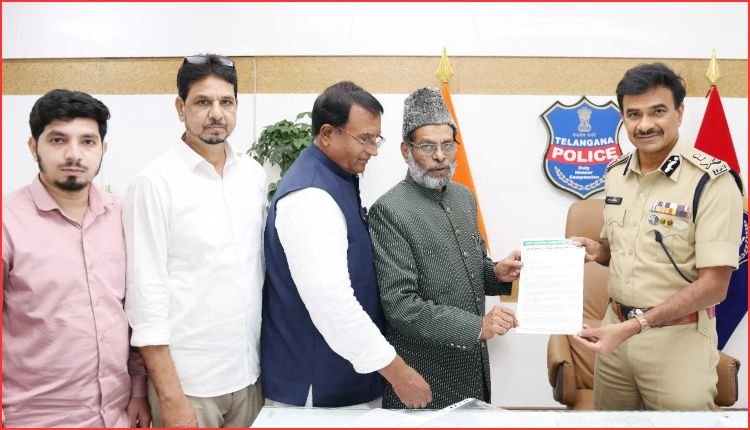
Hyderabad: The Telangana and Andhra Pradesh Joint Action Committee demanded a comprehensive police investigation into bulk Form 7 applications allegedly submitted to delete voters’ names from Telangana electoral rolls.
JAC president Mohammed Mushtaq Mallik urged Director General of Police C.V. Anand to order forensic examination of the pre-printed applications. He also sought an investigation into the software, voter databases and printing facilities allegedly used to prepare them.
Mallik, who also headed Tahreek Muslim Shabban, submitted a representation to the Telangana DGP on Friday. The representation raised concerns about possible coordinated attempts to remove eligible voters through mass deletion requests.
The JAC cited an incident at Polling Booth No. 210 in Musheerabad involving approximately 30 Form 7 applications. According to the representation, BJP Booth Level Agent S. Balachander reportedly submitted the applications against Congress BLA Shafiuddin and his family members.
The applications allegedly contained pre-printed voter details and residential addresses. Consequently, the organisation questioned how the information had been collected and processed. It urged police to examine the Musheerabad incident alongside similar reported cases in coordination with election authorities.
JAC seeks forensic examination of bulk Form 7 applications
The JAC demanded that police send the original applications to the Forensic Science Laboratory for detailed examination. Investigators should compare printing methods, document formats and similarities across the submitted forms, the representation said.
Furthermore, Mallik sought identification of the software, databases, voter information sources and printing facilities allegedly involved. He asked police to establish who commissioned, prepared, printed and distributed the applications.
The investigation should also examine whether individuals or organisations beyond booth-level agents participated in their preparation. Meanwhile, the JAC referred to similar reported cases involving bulk Form 7 submissions in Bengaluru, Karnataka.
It said authorities had reportedly registered FIRs in those cases. The organisation sought an examination of whether common software, databases or bulk-printing facilities linked the reported incidents. However, the representation did not establish that the cases shared a common source.
Mallik maintained that investigators should not restrict their inquiry to individual Booth Level Agents. Instead, he demanded an examination of the entire preparation and distribution process to identify any coordinated activity.
Bulk Form 7 applications raise electoral roll concerns
The JAC also expressed concern over reports about the centralisation of approximately 4,400 Electoral Registration Officer-related powers or functions. It requested verification of those reports and an assessment of their impact on voter inclusion procedures.
The organisation questioned whether the reported changes had created difficulties for eligible citizens seeking inclusion in electoral rolls. Referring to Sections 22 and 23 of the Representation of the People Act, 1950, Mallik highlighted the ERO’s statutory responsibilities.
He said Electoral Registration Officers handled corrections, deletions and inclusion of voter names under prescribed legal procedures. Moreover, he stressed that Booth Level Agents lacked independent authority to approve or delete names from electoral rolls.
The JAC demanded appropriate legal action against anyone found responsible for offences following the investigation. It also urged the police to protect eligible voters against wrongful deletion and safeguard electoral procedures.
Mallik called for an impartial inquiry into the alleged bulk Form 7 applications and their possible origins. The representation included Form 7 specimens, an FIR copy, complaints and supporting reports.