

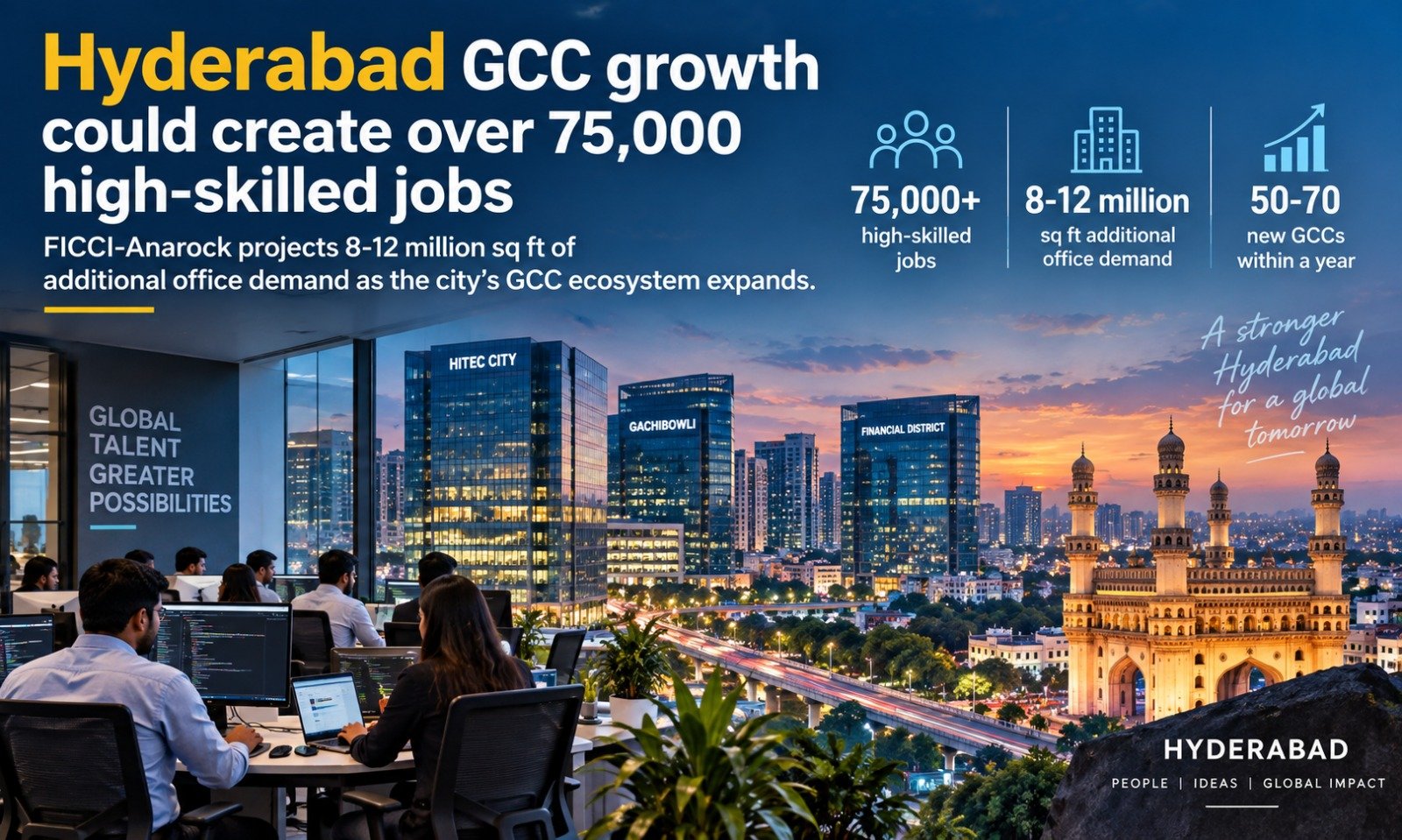
HYDERABAD: Hyderabad’s rapidly expanding Global Capability Centre (GCC) ecosystem could generate more than 75,000 high-skilled jobs over the next three to five years, according to a joint report by FICCI and Anarock.
The expansion could also create demand for an additional 8-12 million square feet of office space.
The report, Hyderabad: The Rise of a Global Capability Powerhouse, projects another 50-70 GCCs across technology, engineering, BFSI, life sciences, analytics, consulting and digital operations within a year.
The report said the growth could boost employment, commercial real estate demand and higher-value corporate functions in the city.
Hyderabad’s GCC ecosystem
Hyderabad had more than 515 GCCs as of the first quarter of 2026. These centres employed over 300,000 professionals and accounted for about 20% of India’s GCC base.
The city also recorded more than 70 new GCC additions in FY25, the highest among major Indian GCC destinations, according to the report.
The nature of GCC operations in Hyderabad is also changing. Companies are moving beyond conventional IT and IT-enabled services towards research and development, engineering, analytics, artificial intelligence, digital operations and corporate decision-making.
The report identified this shift from back-office support to high-value global corporate functions as a major trend shaping Hyderabad’s GCC market.
Hyderabad’s GCC base spans several sectors. These include technology and software, banking and financial services, pharmaceuticals and life sciences, semiconductors, aerospace and defence, automotive and engineering, consumer and retail, healthcare, and media and sports technology.
Companies with GCC or related capability functions in the city include Microsoft, Google, Amazon, Apple, Wells Fargo, JPMorgan, Novartis, Qualcomm and Boeing, among others.
Hyderabad leads major cities in GCC additions
Bengaluru remains India’s largest GCC market, with more than 880 centres. However, Hyderabad emerged as the fastest-growing market among the four major destinations assessed in the report.
Hyderabad added more than 70 GCCs in FY25. Bengaluru added 30-35, Pune added 15-20 and Chennai added 12-15 during the same period.
Hyderabad’s prime office rents stood at about Rs 95-115 per sq ft per month. That was below Bengaluru’s Rs 110-140 and broadly comparable with Pune.
The report attributed Hyderabad’s competitive position to its talent availability, operating costs and sectoral diversity.
The city has an IT workforce of about one million professionals and produces around 4 lakh STEM graduates annually, according to the report.
It also highlighted Hyderabad’s strengths in BFSI and life sciences, along with its semiconductor, aerospace and engineering capabilities.
The report cited the state’s TS-iPASS approval mechanism as another advantage. Eligible processes can receive approval through a reported 15-day guaranteed timeline.
GCC growth boosts office demand
GCC expansion has become an important driver of Hyderabad’s commercial property market.
GCC office leasing increased from 1.9 million sq ft in 2021 to 4.5 million sq ft in 2025. More than 3 million sq ft had already been recorded in the first half of 2026.
Hyderabad had about 125 million sq ft of Grade-A office stock, representing roughly 15% of India’s supply. Another 36 million sq ft was in the pipeline.
The city’s Grade-A office vacancy stood at 23.5% in the first half of 2026.
Western Hyderabad expected to drive growth
The report expects demand to remain broad-based through 2029. GCCs, IT and ITeS, BFSI, engineering, life sciences, professional services and flex-office operators are expected to drive demand.
Infrastructure improvements and continued development in western Hyderabad could further strengthen the city’s position among large corporate occupiers.
The report specifically highlighted HITEC City, Financial District, Gachibowli and Kokapet as key areas for future development.
Beyond conventional offices, the report projects demand for another 2-3 million sq ft of flex and managed workspace over the next two to three years.
It also expects multinational companies to increasingly seek Grade-A offices that offer ESG compliance and better amenities.