
Hyderabad DCC warns MGNREGS dilution will hit rural jobs, urban labour and agriculture

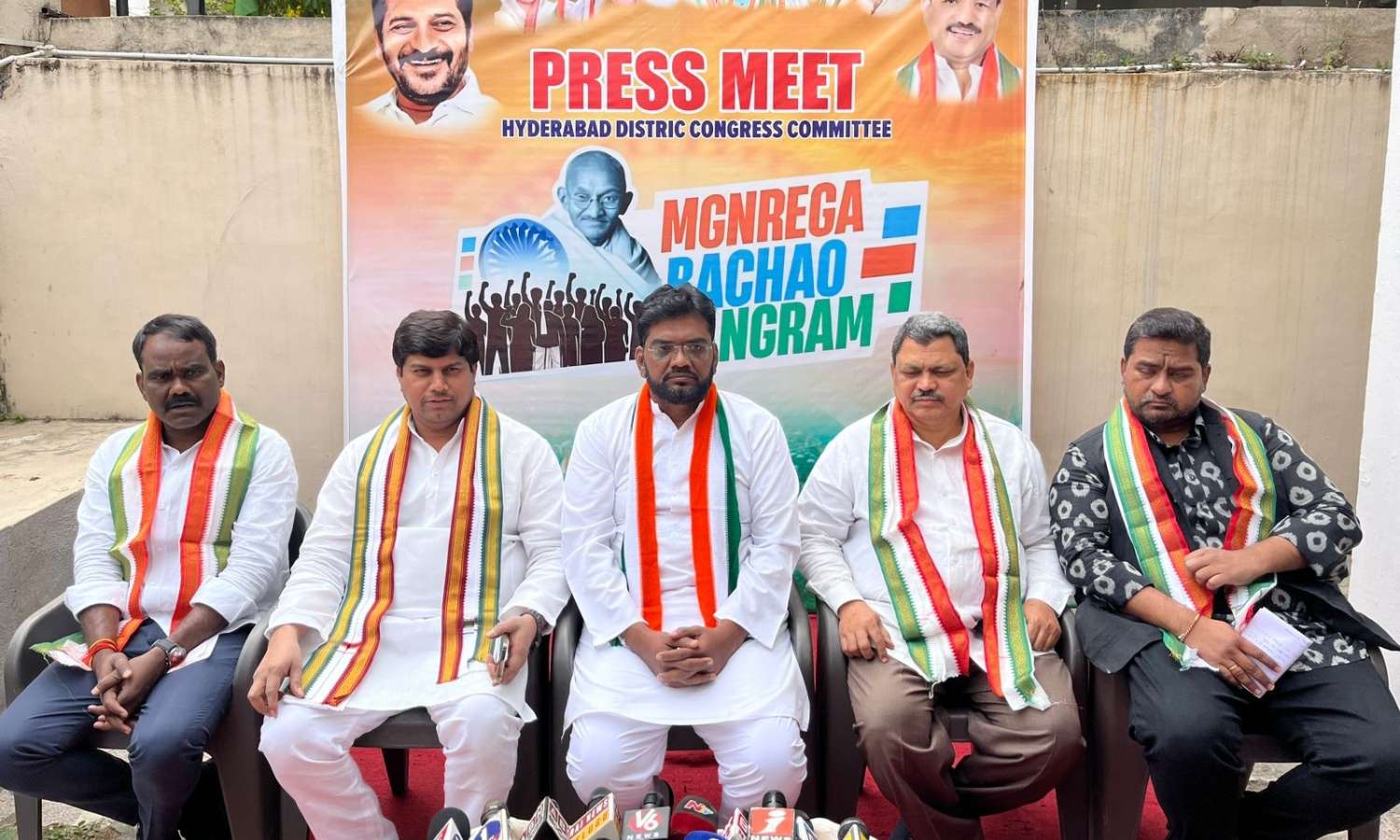
Hyderabad: Hyderabad District Congress Committee (DCC) president Syed Khalid Saifullah on Saturday warned that the Centre’s move to dilute the Mahatma Gandhi National Rural Employment Guarantee Scheme (MGNREGS) would severely impact rural employment. It would also affect urban labour supply and agricultural output.
Speaking at a press conference in Chintalkunta, Saifullah said the proposed changes threaten the constitutional right to work. They could dismantle a key pillar of India’s rural economy. The event was held as part of a nationwide protest led by the All India Congress Committee (AICC). Congress Assembly in-charges Rajesh Kumar Pulipati, B. Nagesh, Mohmmed Mujeebullah Shareef, Shaik Akbar and K. Ravi Raj also addressed the gathering.
Congress says proposed changes to MGNREGS threaten rural economy
Saifullah cautioned that weakening MGNREGS would result in large-scale migration from villages. This would place additional pressure on urban areas already facing shortages in jobs, housing, and basic services. He added that agricultural regions would experience severe labour shortages, particularly affecting paddy and vegetable cultivation.
“The collapse of MGNREGS will not remain a rural issue. It will disturb the entire economic chain, from agriculture to urban markets,” he said.
Saifullah noted that the scheme originally guaranteed each rural household 100 days of employment annually. However, he alleged the Centre now intends to convert this legal right into a discretionary provision under Union control.
Raising wage-related concerns, he said the current framework ensures minimum wages with periodic revisions and employment year-round. In contrast, the new policy would allow arbitrary wage setting and restrict work during harvest seasons. It would also weaken rural workers’ bargaining power.
He further alleged that gram panchayats were being stripped of their powers. Under MGNREGS, local bodies had the authority to plan and execute development works. The return of contractors and centralisation of control, he said, would reduce panchayats to rubber-stamp agencies.
Additionally, Saifullah criticised the financial burden being shifted to states. He warned that this could deter employment generation at the local level. He also pointed to stagnant wages, delayed payments, and technological exclusions through Aadhaar and mobile-based systems as signs of a systemic rollback.
Congress demands full rollback, national minimum wage
Citing the role of MGNREGS during the Covid-19 pandemic, Saifullah said any dilution would worsen rural distress. It would escalate forced migration and damage the Panchayati Raj system. As part of the “MGNREGA Bachao Sangram,” the Congress will conduct village-level campaigns, pass gram sabha resolutions, and raise awareness across India.
He reiterated the party’s key demands, including a full rollback of the proposed amendments and restoration of the legal right to work. They also demand accountability in wage payments and a national minimum wage of ₹400 per day.
Congress leaders also called upon farmers, rural workers, and civil society groups to resist. They described it as a calculated attack on one of India’s most vital welfare programs.