

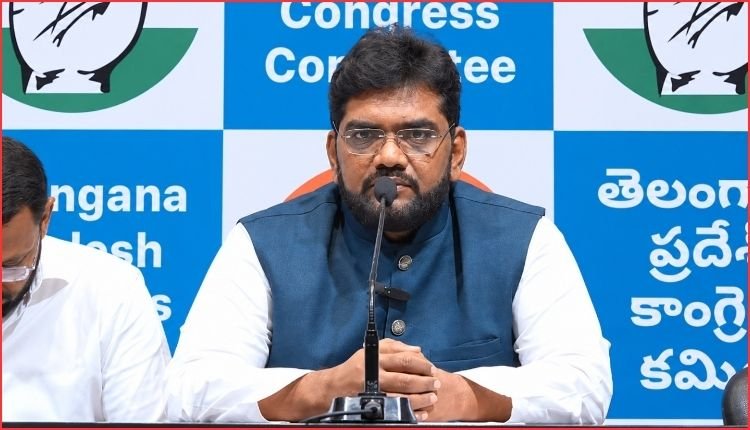
Hyderabad: Hyderabad District Congress Committee President Syed Khalid Saifullah on Wednesday demanded a UPI MDR rollback and greater disclosure from the Centre over the policy change.
Saifullah asked the government to disclose the consultations, representations and policy reasoning that preceded the decision. He also sought details on who would financially benefit from the new Merchant Discount Rate framework.
He addressed a press conference at Gandhi Bhavan along with TPCC spokesperson Syed Nizamuddin. Bahadurpura Assembly in-charge Rajesh and senior Congress leader Advocate Jagan Mohan Reddy also attended.
Saifullah said UPI had become part of the daily economic life of crores of Indians. Therefore, he argued that any major change to its cost structure required public scrutiny. “The questions are why the zero-MDR policy was changed, who stands to financially benefit from this change and whether the cost will ultimately reach ordinary consumers,” he said.
UPI MDR rollback demand raises policy questions
Saifullah referred to longstanding concerns raised by the United States over India’s domestic payment policies. He cited the 2026 National Trade Estimate Report of the US Trade Representative. According to Saifullah, the report said the US continued raising concerns about Indian electronic-payment policies.
He said the US believed some policies favoured domestic suppliers over foreign companies. He added that the report specifically referred to participation by US payment suppliers in the UPI ecosystem.
The US has previously raised concerns about some Indian digital-payment and data-localisation policies. Saifullah argued that such representations raised questions about whether electronic-payment policy featured in trade discussions before the MDR decision.
However, he did not present the existence of those representations as evidence that external pressure caused the policy change. The Finance Ministry, according to the statement, categorically rejected suggestions of external influence. It called such claims “unfounded, completely false and misleading”.
The Centre maintained that the changes sought to ensure UPI’s long-term sustainability, technological advancement and resilience. Nevertheless, Saifullah said the sequence of policy developments required greater transparency.
UPI MDR rollback sought after legislative change
Saifullah also referred to the Taxation and Other Laws (Amendment) Bill, 2026. According to him, the government introduced the Bill in the Lok Sabha on August 4. Parliament subsequently passed it.
He said the legislation amended the Payment and Settlement Systems Act, 2007. The 2007 Act provides the statutory framework governing payment systems in India. According to Saifullah, the amendment created an enabling framework for specifying electronic payment modes receiving statutory no-charge protection.
He argued that a change affecting the country’s digital-payment architecture deserved wider public and parliamentary scrutiny. Under the framework described by Saifullah, eligible person-to-merchant UPI payments above Rs 2,000 will attract 0.4% MDR from October 15. The charge will have a ceiling of Rs 300.
Meanwhile, person-to-person transactions will remain free. Merchant payments up to Rs 2,000 will also remain exempt. Specified small merchants receiving up to Rs 1 lakh monthly through UPI QR payments will remain under the zero-MDR framework, he said.
UPI MDR rollback demand focuses on consumer costs
Saifullah questioned whether businesses would eventually pass the additional payment costs to consumers. He said the Centre’s assertion that consumers would not directly pay MDR did not fully address its possible economic impact.
“On an eligible Rs 4,000 payment, the MDR is Rs 16,” Saifullah said. “The customer may not see a separate MDR entry on the bill, but the question is whether businesses will absorb such recurring costs or recover them through prices, reduced discounts or other means,” he added.
Therefore, he sought a strong enforcement and grievance mechanism to prevent merchants from directly passing MDR charges to customers. Saifullah also questioned how different entities would share revenue generated through the new framework.
He said banks, payment service providers and major UPI applications would share MDR revenue. Consequently, he demanded disclosure of projected collections and the revenue-sharing formula.
Saifullah also referred to political questions that followed the January release of Epstein-related records in the United States. He cited subsequent controversy over references involving Indian political figures. According to the statement, Union Minister Hardeep Singh Puri denied wrongdoing concerning his documented contacts with Jeffrey Epstein.
Saifullah also referred to a controversy involving a reference to Prime Minister Narendra Modi’s 2017 Israel visit. He said the Ministry of External Affairs had rejected insinuations arising from that reference.
Saifullah stressed that Congress was not presenting this chronology as proof that US pressure or the disclosures caused the MDR decision. Instead, he argued that the Centre should publish the full policy trail to address questions surrounding the decision.
“When a policy that kept UPI merchant payments free for years is changed, citizens have every right to ask why it changed,” he said. He also asked “who asked for the change, what representations were received and who will financially benefit”. The Hyderabad DCC supported the Congress demand for a UPI MDR rollback, Saifullah said.
He also asked the Centre to disclose representations concerning UPI pricing and the zero-MDR policy. These included representations from banks, payment companies, industry bodies, foreign governments or trade negotiators. “The UPI revolution was built through the participation of crores of Indians,” Saifullah said.
He added that any major change to its cost structure should remain transparent and properly debated. Such policy, he said, should also protect the interests of citizens, consumers and small businesses.