
Telangana moves to acquire 1,248 acres of Alur Waqf land as Board resumes meetings

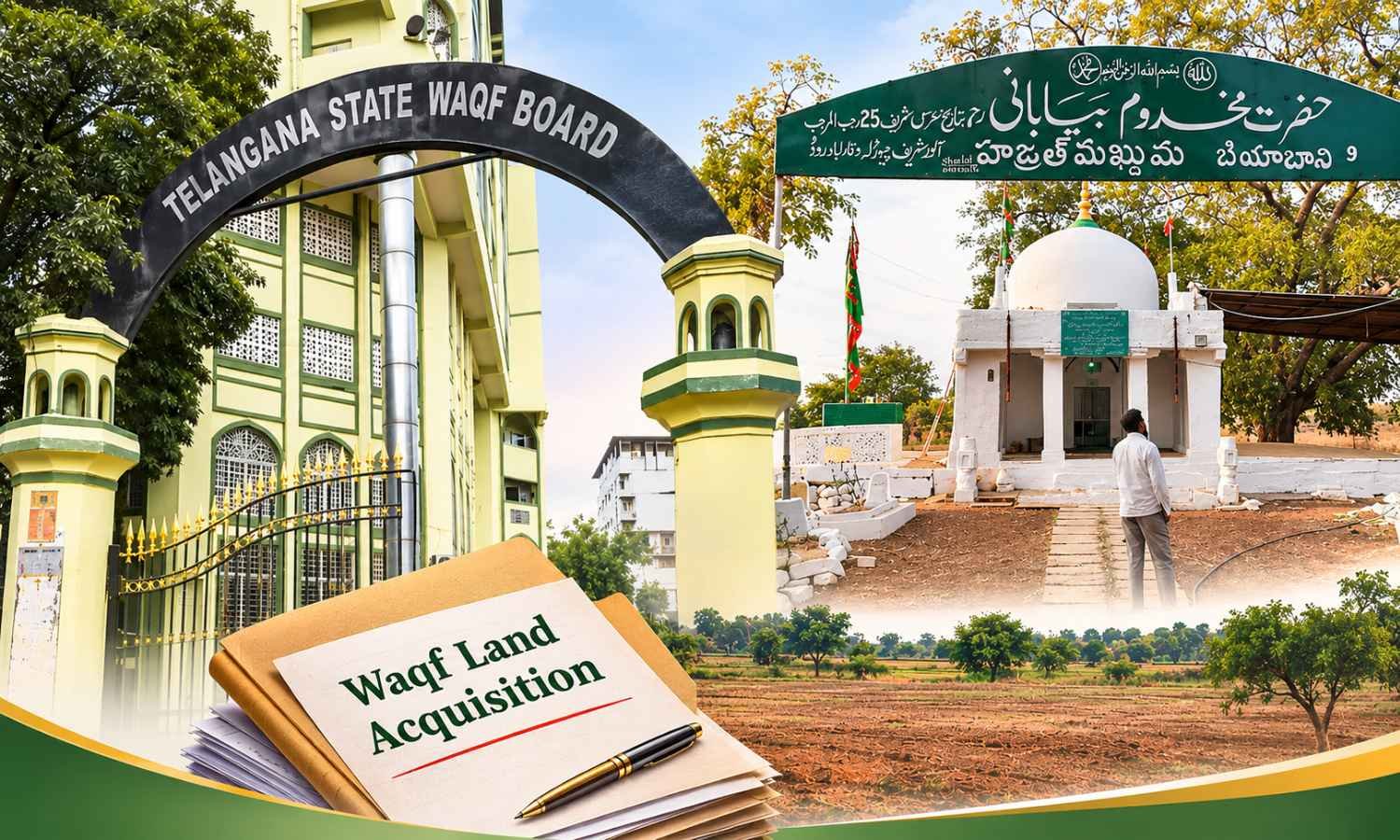
Hyderabad: The Telangana government’s move to acquire approximately 1,248 acres of Waqf land at Alur Sharif in Rangareddy district is expected to dominate Saturday’s Telangana State Waqf Board meeting. The Board will meet at 3 pm after a gap of nearly two years, amid questions over the proposed acquisition of land attached to Dargah Hazrat Syed Shah Makhdoom Bayabani.
The proposed Alur Waqf land acquisition covers properties spread across Alur-I, II and III villages in Chevella Mandal. The government intends to acquire the land for industrial development through the Telangana Industrial Infrastructure Corporation (TGIIC). The district administration has already advanced the acquisition process under the Right to Fair Compensation and Transparency in Land Acquisition, Rehabilitation and Resettlement Act, 2013.
Sources indicated that the acquisition could emerge as the most significant issue during Saturday’s deliberations. The timing of the meeting has raised questions about whether the Board will consider a resolution concerning the proposed transfer. However, the government has not publicly clarified the nature of any decision it expects from the Board.
The proposed acquisition has attracted attention because official records recognise the land as Waqf property attached to a religious institution. The property has historically served as an endowment for religious and charitable purposes. Its proposed transfer for industrial development raises questions about the statutory safeguards governing such properties and the Board’s responsibility to protect them.
Waqf status brings legal safeguards into focus
The Alur Sharif lands have a long history as Waqf property. Official records identify the endowment as belonging to Dargah Hazrat Syed Shah Makhdoom Bayabani. The property’s classification as Waqf land forms an important part of the present controversy because the government has proceeded with acquisition despite recognising its religious endowment status.
The Waqf Act places restrictions on the permanent alienation of Waqf assets. At the same time, compulsory acquisition for a public purpose falls under a separate legal framework. The distinction has become relevant to the Alur Waqf land acquisition, particularly because the government intends to use the property for industrial development.
The issue is not confined to the government’s authority to acquire land for a public purpose. It also concerns the legal procedures applicable when the property belongs to a Waqf institution. The Board’s statutory responsibilities include protecting Waqf assets and ensuring their administration in accordance with the law.
Sources indicated that these questions could form part of Saturday’s deliberations. However, no official clarification has emerged on whether the government intends to seek the Board’s consent, a formal resolution or another decision concerning the proposed acquisition.
The Board’s position could become important in determining how the authorities proceed with the property. Any resolution would also have to be considered in the context of the applicable Waqf legislation and the ongoing acquisition proceedings.
Earlier acquisition attempt ended after proceedings lapsed
The government’s plan to acquire land at Alur for industrial development dates back nearly two decades. In 2006, the erstwhile Andhra Pradesh government initiated proceedings for an industrial park proposed by the Andhra Pradesh Industrial Infrastructure Corporation (APIIC). The authorities issued acquisition notifications and initiated negotiations with interested parties.
However, the earlier acquisition process did not reach completion. Although officials conducted negotiations and other administrative procedures, they failed to pass the required acquisition award within the prescribed period. The proceedings subsequently lapsed, bringing the earlier proposal to an end.
The matter had also reached the Andhra Pradesh High Court through a writ petition filed by Mohd. Faizullah. On July 4, 2011, the court disposed of the petition after the government informed it that the acquisition proceedings had lapsed. The authorities also stated that they were no longer interested in pursuing the proposal.
The High Court recorded the government’s submission and disposed of the petition as infructuous. The earlier proceedings therefore ended without a completed acquisition. However, the available records do not establish the precise overlap between the land parcels involved in the earlier and present proposals.
The government initiated fresh acquisition proceedings in 2026, bringing the Alur lands back into focus. The present process has advanced through new statutory notifications and a declaration under the 2013 land acquisition legislation. The renewed attempt has again raised questions about the future of the Waqf property and the legal safeguards applicable to its acquisition.
Akbaruddin Owaisi seeks protection of Alur lands
The proposed Alur Waqf land acquisition has also drawn opposition from AIMIM floor leader Akbaruddin Owaisi. In September 2026, he wrote to Chief Minister A. Revanth Reddy seeking protection of approximately 1,264 acres of Waqf land at Alur Sharif.
Owaisi urged the government to stop any transfer of the property to TGIIC and prevent the creation of third-party rights. He also called for examination of the legal provisions governing Waqf properties before proceeding with acquisition for a public purpose.
His representation highlighted the need to protect the religious endowment and ensure compliance with the applicable laws. The Telangana Waqf Board had earlier taken up the matter with the Minorities Welfare Department. However, the Board has not publicly clarified its final position on the proposed acquisition.
The issue has gained significance ahead of Saturday’s meeting because the acquisition process has already advanced through several administrative stages. The Board’s response could clarify whether it intends to support, oppose or seek further examination of the government’s proposal.
Jamia Nizamia land dispute remains unresolved
Apart from Alur Sharif, the Board may also face questions concerning other long-pending Waqf property disputes. One major controversy involves land claimed by Jamia Nizamia at Raidurg/Panmaktha in Hyderabad’s Knowledge City.
The dispute concerns Survey No. 83/1 and adjoining parcels, which Jamia Nizamia claims as Waqf property. The institution maintains that historical records, including Muntakhab and Kitab-ul-Awqaf entries, support its claim. It has also stated that the authorities scrutinised and approved the property’s details on the Central government’s UMEED portal.
The controversy intensified after TGIIC auctioned portions of the disputed land in 2026. Individual plots reportedly fetched prices of up to Rs. 264 crore per acre, while the auctions generated several thousand crores in total proceeds. The transactions prompted objections from Jamia Nizamia, AIMIM leaders and community organisations.
The institution and its supporters cited pending proceedings before the High Court and Waqf Tribunal. They maintained that the authorities should examine the competing claims before proceeding with further transactions involving the disputed property.
Akbaruddin Owaisi had also urged the government to suspend further auctions and conveyances until the claims received proper examination and appropriate judicial directions. Questions have additionally emerged over the Waqf Board’s earlier response to proceedings concerning the land.
The dispute remains significant because it involves competing claims over property in one of Hyderabad’s major commercial locations. However, there is no confirmation that the Board will formally take up the Raidurg issue during Saturday’s meeting.
Urdu Academy land lease triggered controversy
Another property dispute concerns approximately 1.04 acres, or 5,220 square yards, in Survey No. 29 of Dargah Hussain Shah Wali village in Serilingampally. The government had originally allotted the land to the Telangana Urdu Academy about two decades ago.
In July 2026, the Minorities Welfare Department issued GO Ms No. 20 permitting a 30-year lease to NN Infra & Constructions. The arrangement followed a Build-Operate-Transfer model and proposed an Urdu Ghar-cum-Shadikhana along with a commercial complex.
The decision triggered objections from political leaders and minority organisations. Critics questioned the absence of a public tender, competitive bidding and a public notice inviting objections. They also raised concerns about the authority under which the department approved the lease.
Hyderabad MP Asaduddin Owaisi questioned the approval process and maintained that the authorities should follow the prescribed procedure. Waqf Board member Abul Fatah Syed Bandagi Badesha Quadri and others also opposed the decision. They asserted that the property had Waqf character linked to Dargah Hussain Shah Wali.
The BRS and several minority organisations demanded cancellation of the lease. Following the objections, the government withdrew its decision through GO Ms No. 23, dated August 11, 2026.
Although the government cancelled the lease, the withdrawal did not settle the competing claims concerning the property’s status. The controversy remains among the property-related issues that have attracted attention from Waqf stakeholders.
Waqf Board resumes meetings with incomplete composition
Saturday’s meeting will mark the resumption of formal deliberations by the Telangana Waqf Board after nearly two years. The Board last held a formal meeting in October 2024. Its meetings subsequently remained suspended amid uncertainty following the implementation of the Waqf (Amendment) Act, 2025.
The Board continues to function with an incomplete composition. Its members include Chairman Syed Azmatullah Huseini and elected mutawalli representatives Syed Akbar Nizamuddin Hussaini Saberi and Abul Fatah Syed Bandagi Badesha Quadri.
Other members include ex-officio member Ayesha Khanum, Syed Nisar Hussain Hyder Aga, Malik Moatasim Khan and Hyderabad MP Asaduddin Owaisi. The MLA and MLC categories have remained vacant since the 2023 Assembly elections.
Community organisations have repeatedly called for a fully constituted Board capable of addressing pending property disputes. They have also sought stronger measures to protect Waqf institutions and their assets across Telangana.
The resumption of meetings comes amid several unresolved controversies involving Waqf properties in Hyderabad and Rangareddy district. However, the Alur Waqf land acquisition is expected to receive particular attention because of the property’s substantial extent and notified Waqf status.
The acquisition process has already advanced through several statutory stages. The Board’s response could clarify its position on the proposed transfer of Waqf land for industrial development. Whether members will consider a resolution or seek further examination of the matter will become clear after Saturday’s deliberations.