
Sonia Gandhi’s ‘Belonging’ revives Telangana debates, inspires Telugu film
By Shaik Ahmed Ali

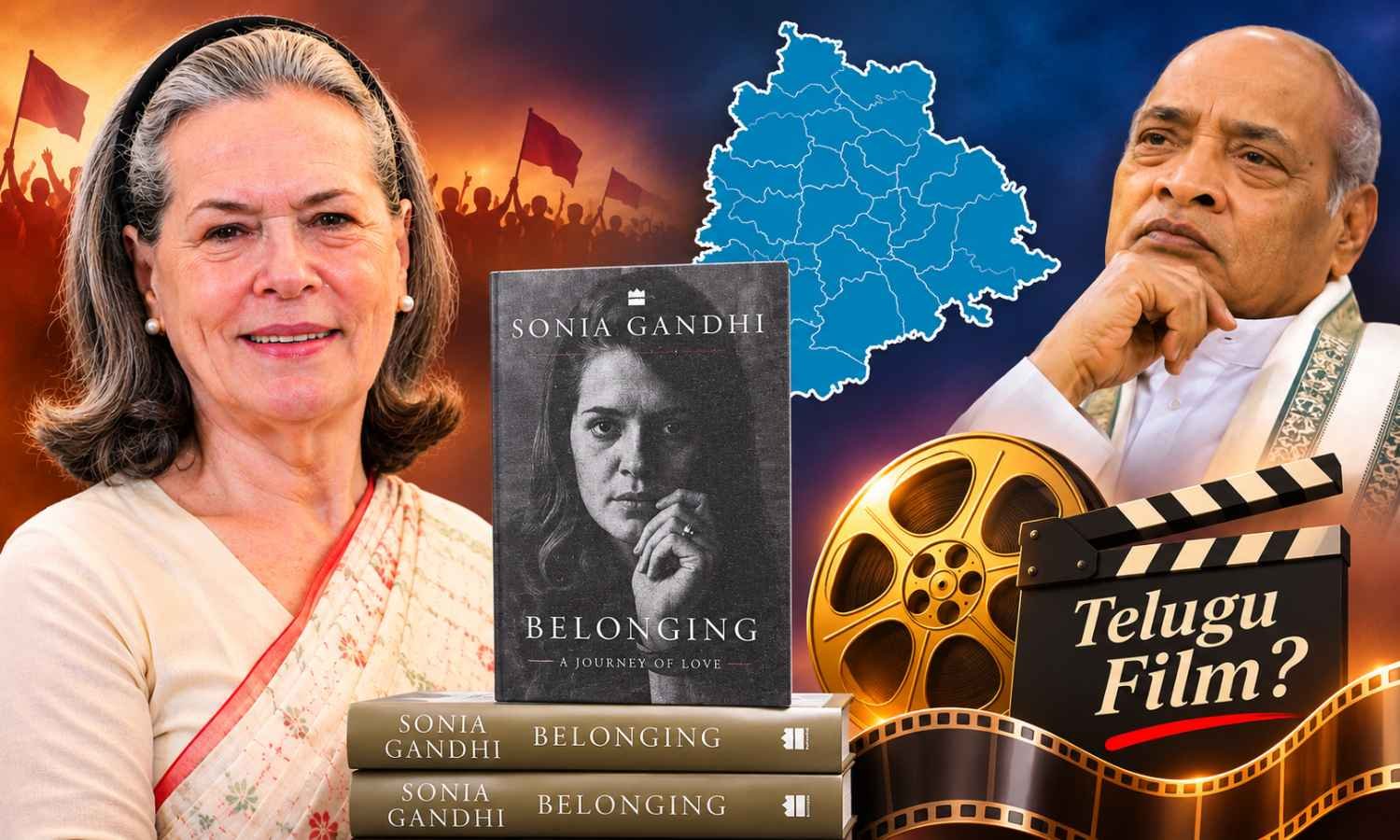
Hyderabad: UPA chairperson Sonia Gandhi’s new memoir has revived two old political disagreements in Telangana while inspiring an unusual proposal from the Congress. The BRS has questioned the alleged absence of Telangana’s statehood movement from the book, while a BJP leader has accused her of playing down former Prime Minister P.V. Narasimha Rao’s contribution. The Congress, meanwhile, wants to take her life story to the Telugu cinema screen, with party leaders in Sangareddy proposing a film financed by their own contributions.
Released on November 10, “Belonging: A Journey of Love” has generated contrasting reactions in a state where Sonia Gandhi’s role in the formation of Telangana remains politically significant. Although the 544-page memoir is presented as a personal account, its publication has prompted leaders to revisit events that continue to shape the state’s political discourse. The arguments are less about the book’s literary qualities and more about historical recognition, political credit and the relationship between the Nehru-Gandhi family and prominent Telangana leaders.
Former BRS MP B. Vinod Kumar was among the first to raise a regional objection. In a statement on November 11, he expressed surprise that the Telangana statehood movement had allegedly found no place in Sonia Gandhi’s memoir. While acknowledging her important role in the political decisions that led to the state’s formation in 2014, he questioned why a movement involving years of protests, strikes and sacrifices had apparently been overlooked.
Vinod Kumar claimed that the book did not contain even a reference to the word Telangana. He also referred to the deaths of more than 1,200 students and activists during the agitation, a figure he cited to underline the movement’s human cost. The number remains his claim rather than an independently established death toll. His assertion about Telangana’s complete absence from the memoir also requires verification against the full text.
The former MP’s criticism is notable because he did not dispute Sonia Gandhi’s contribution to statehood. Instead, he argued that Telangana’s formation was an important chapter in India’s political history and questioned why it had apparently not received recognition in her personal account. His remarks have revived a familiar disagreement between the Congress and BRS over the respective roles of political leadership and popular mobilisation in achieving statehood.
Sonia Gandhi memoir Telangana row revives statehood debate
The Telangana statehood movement continued for decades before Parliament passed the Andhra Pradesh Reorganisation Act in February 2014, paving the way for the formation of the new state on June 2 that year. The Congress-led United Progressive Alliance government introduced the legislation, while Sonia Gandhi, as Congress president and UPA chairperson, played an important role in the political decision-making. However, the movement had acquired considerable strength much earlier through sustained public agitation.
The Telangana Rashtra Samithi, now the BRS, had made statehood its principal objective since its formation in 2001. Under K. Chandrashekar Rao’s leadership, the party mobilised public support alongside students, employees’ unions, political organisations and civil society groups. The movement eventually brought the statehood demand to the centre of national politics, creating pressure for a decision by the Union government.
Since Telangana’s formation, the Congress and BRS have offered competing interpretations of the achievement. Congress leaders have highlighted Sonia Gandhi’s decision as the final political step that enabled statehood, while the BRS has emphasised the prolonged movement and the leadership of KCR. Vinod Kumar’s objection to the memoir reflects this unresolved contest over political recognition. By acknowledging Sonia Gandhi’s contribution while questioning the alleged omission, he has shifted the argument from who created Telangana to how its creation is remembered.
The Telangana BJP has raised a different issue involving another prominent figure from the region. N.V. Subhash, the party’s chief spokesperson in the state and grandson of former Prime Minister P.V. Narasimha Rao, accused Sonia Gandhi of failing to give his grandfather adequate recognition. He questioned her treatment of Rao’s contribution to the Congress and the country, particularly his leadership during India’s economic reforms in 1991.
Subhash argued that Rao had steered the Congress through a difficult period following Rajiv Gandhi’s assassination and subsequently led the government during one of India’s most significant economic transitions. Rao became prime minister in June 1991 and appointed Manmohan Singh as Finance Minister, with their government initiating major economic reforms. Subhash maintained that Rao’s political leadership deserved greater acknowledgement and accused the Nehru-Gandhi family of consistently playing down the contributions of other Congress leaders.
However, the memoir does contain references to Narasimha Rao, contrary to suggestions that he has been omitted entirely. Sonia Gandhi describes him as an erudite statesman and discusses their working relationship, including differences over the progress of the investigation into Rajiv Gandhi’s assassination. The book also refers to economic liberalisation under the Rao government, with Manmohan Singh serving as Finance Minister.
The disagreement therefore concerns the extent and interpretation of Rao’s contribution rather than a complete absence of references to him. Subhash’s criticism has revived a long-running dispute over Rao’s political legacy and his relationship with the Congress leadership. Rao, who served as prime minister from 1991 to 1996, remains a significant political figure in Telangana, where his role in economic reforms and his treatment by successive Congress leaders continue to attract attention.
Congress plans Telugu film as reading speed sparks dispute
While the BRS and BJP have been questioning aspects of the memoir, sections of the Telangana Congress are planning to take Sonia Gandhi’s story beyond bookstores. TPCC working president T. Jagga Reddy has proposed a Telugu feature film based on her autobiography, with leaders and workers from the Sangareddy Assembly constituency jointly financing the project.
Announcing the proposal at a Congress workers’ meeting in Sangareddy, Jagga Reddy appealed to party members to contribute towards the production. Constituency Congress convenor Julakanti Anjaneyulu announced a contribution of Rs 2 crore, while Jagga Reddy suggested constituting a 50-member committee to coordinate the preparations and mobilise funds. He said the budget would be finalised before selecting a director and beginning the production process.
The proposed film would portray different stages of Sonia Gandhi’s life, including her marriage to Rajiv Gandhi, her relationship with Indira Gandhi, the assassinations that transformed the family and her eventual entry into politics. Jagga Reddy also wants Chief Minister A. Revanth Reddy and TPCC president B. Mahesh Kumar Goud to formally launch the shooting once the arrangements are completed. He has additionally proposed purchasing copies of the memoir for distribution among Congress workers.
Although the announcement has attracted attention, the film remains at the planning stage. No director or production schedule has been confirmed, and there has been no public announcement of an agreement to acquire the book’s adaptation rights. Nevertheless, the initiative indicates how some Congress leaders want to use the memoir to communicate Sonia Gandhi’s personal and political experiences to a wider Telugu-speaking audience.
The book has also produced an unusual exchange between the Telangana BJP and Congress social media chairperson Supriya Shrinate. After Shrinate announced on November 11 that she had finished reading “Belonging”, the BJP questioned whether she could have completed the 544-page memoir so quickly. Calculating the interval between her social-media posts, the party claimed that she had finished it in 27 hours and 45 minutes. It jokingly compared her reading speed to Chitti, the robot character from Rajinikanth’s film “Robo”.
Shrinate responded on November 12 that she had received an advance copy and deliberately posted the video showing its arrival later. Her clarification challenged the assumption behind the BJP’s calculation, which treated the time of the video post as the beginning of her reading. The exchange added a lighter dimension to the political debate, with rival parties now commenting not only on the memoir’s contents but also on how quickly their opponents had supposedly read it.
Taken together, the reactions demonstrate how differently Telangana’s political parties are approaching the same autobiography. The BRS is examining the place of the statehood movement in Sonia Gandhi’s account, while the BJP is questioning her treatment of Narasimha Rao’s legacy. Congress leaders, on the other hand, are celebrating her personal journey and exploring ways to present it to a larger audience through cinema and party activities.
Sonia Gandhi had anticipated that her memoir would generate controversy. In an October 27 social-media message, she observed that others had spent decades telling her story and that it was finally her turn. She has described “Belonging” primarily as a personal account rather than a comprehensive history of Indian politics, but her public life has been closely connected with events that continue to carry considerable political significance.
That distinction has become particularly evident in Telangana, where the state’s formation and Narasimha Rao’s legacy remain important elements of contemporary political debate. The memoir has provided another occasion for rival parties to revisit these subjects, each emphasising a different aspect of the past.
Sonia Gandhi set out to tell the story of the life she lived. In Telangana, political leaders are debating how that life should be remembered, which events deserve greater recognition and what they believe has been left unsaid.