

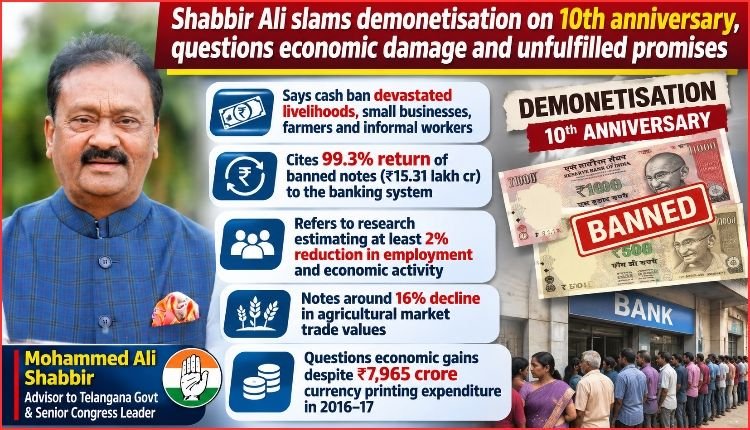
Hyderabad: Senior Congress leader Mohammed Ali Shabbir on Saturday questioned the economic costs of demonetisation, accusing the Narendra Modi government of failing to explain its benefits. He said the 2016 currency withdrawal had damaged livelihoods, disrupted businesses and severely affected India’s informal economy.
Speaking ahead of the tenth anniversary of demonetisation on November 8, Shabbir Ali demanded a comprehensive assessment of the policy’s economic consequences. He questioned whether the government had achieved its stated objectives of eliminating black money, corruption, counterfeit currency and terror financing.
Shabbir Ali, who serves as Advisor to the Telangana Government, said the sudden withdrawal of Rs 500 and Rs 1,000 notes had caused widespread financial distress.
The decision, announced on November 8, 2016, invalidated nearly 87% of India’s currency in circulation by value. Consequently, millions of households, farmers, daily-wage workers and small businesses faced serious cash shortages.
“Ten years ago, Prime Minister Narendra Modi promised to eliminate black money, corruption, counterfeit currency and terror financing through demonetisation. People were asked to endure extraordinary hardships in the national interest. A decade later, the government has still not provided a comprehensive account of what the country actually gained from those sacrifices,” he said.
Shabbir Ali cites economic costs of demonetisation and RBI figures
Shabbir Ali said the Reserve Bank of India’s final accounting raised fundamental questions about the policy’s effectiveness. According to RBI figures he cited, approximately 99.3% of the invalidated currency returned to the banking system. The returned notes amounted to nearly Rs 15.31 lakh crore.
These figures, he argued, required the Union Government to explain how much unaccounted income it had identified.
“The government presented demonetisation as a decisive strike against black money. But almost the entire value of the banned currency returned to banks. How much unaccounted income was ultimately detected? How much additional tax was recovered? How many counterfeit notes were eliminated? The government must answer these questions with verifiable figures,” he demanded.
The Congress leader maintained that the economic costs of demonetisation extended beyond the immediate shortage of currency.
Ordinary citizens had endured considerable hardship while trying to exchange invalidated notes and access their savings, he said. Meanwhile, cash-dependent businesses struggled to maintain daily operations.
Shabbir Ali also referred to independent academic research documenting the economic disruption following the withdrawal.
He cited a study published in The Quarterly Journal of Economics. According to him, researchers estimated a reduction of at least two percentage points in employment and economic activity during late 2016.
The estimate covered the final quarter of 2016 and measured the decline against expected economic conditions without the currency withdrawal.
“This was not merely an inconvenience caused by standing in bank queues. It was an economic shock that affected employment, production, consumption and the ability of small businesses to survive. Daily-wage workers lost earnings, traders struggled to conduct business and thousands of cash-dependent enterprises faced severe uncertainty,” he said.
Economic costs of demonetisation affected farmers and workers
Shabbir Ali said the agricultural sector had also experienced significant disruption because of the sudden shortage of cash. He referred to academic research indicating that agricultural market trade values declined by approximately 16% shortly after demonetisation.
According to him, farmers struggled to sell their produce and purchase essential agricultural inputs. Many also faced difficulties paying workers involved in farming activities. The shortage disrupted transactions involving small traders, vegetable vendors and rural households that depended heavily on cash.
“Farmers were struggling to sell their harvests while agricultural workers were unable to receive wages. Small traders, vegetable vendors and rural households suffered because cash suddenly became unavailable. The government must explain why such widespread disruption was considered an acceptable price for a policy whose promised benefits remain disputed,” he said.
These difficulties, the Congress leader argued, demonstrated how the currency withdrawal had affected different sections of the economy. He particularly highlighted the problems facing informal workers and small enterprises with limited access to alternative payment systems.
Daily-wage workers had lost earnings, while traders struggled to conduct routine business transactions, Shabbir Ali said. Construction workers, agricultural labourers and self-employed families also experienced difficulties during the cash shortage.
Households and businesses across Telangana had faced similar problems following the 2016 decision, he added.
Shabbir Ali questions currency printing expenditure
Shabbir Ali also raised concerns about the financial and administrative expenditure associated with implementing demonetisation.
He said currency security printing expenditure across denominations had reached approximately Rs 7,965 crore between July 2016 and June 2017. The amount reflected costs associated with currency replacement as well as regular printing operations during that period.
The Congress leader questioned whether the government’s claimed gains justified the substantial expenditure and wider economic disruption. He also challenged the argument that demonetisation had permanently reduced India’s dependence on cash.
According to Shabbir Ali, currency in circulation had increased from approximately Rs 17.77 lakh crore in November 2016 to more than Rs 43 lakh crore by October 2026. This expansion, he argued, raised further questions about the long-term results of the currency withdrawal.
“Digital payments have expanded considerably, but that cannot retrospectively justify the suffering caused by demonetisation. The growth of digital transactions and the continued expansion of currency in circulation show that India’s payment economy has evolved in multiple ways, not simply because high-value notes were withdrawn,” he said.
The growth of digital transactions should not overshadow the difficulties facing cash-dependent workers and businesses, he maintained.
“An economic decision must be judged by its actual results, not by political publicity. The hardships experienced by ordinary Indians cannot be dismissed merely because ten years have passed,” he said.
Congress demands assessment of economic costs of demonetisation
Shabbir Ali demanded that the Union Government publish a comprehensive review of the policy’s results over the past decade. He said the assessment should explain demonetisation’s effects on employment, gross domestic product, agricultural activity and small businesses.
Additionally, he sought verifiable figures on counterfeit currency detection, improved tax compliance and recovery of unaccounted income. The government must provide measurable evidence of the benefits achieved through the withdrawal of high-value currency notes, he argued.
Shabbir Ali said the economic costs of demonetisation required scrutiny because the decision had affected millions of livelihoods. He also maintained that the government owed an explanation to citizens who had endured serious financial difficulties during the currency shortage.
“November 8 should serve as a reminder that governments must remain accountable for decisions affecting millions of livelihoods. The people of India deserve transparent answers about the economic costs and measurable benefits of demonetisation,” he said.