

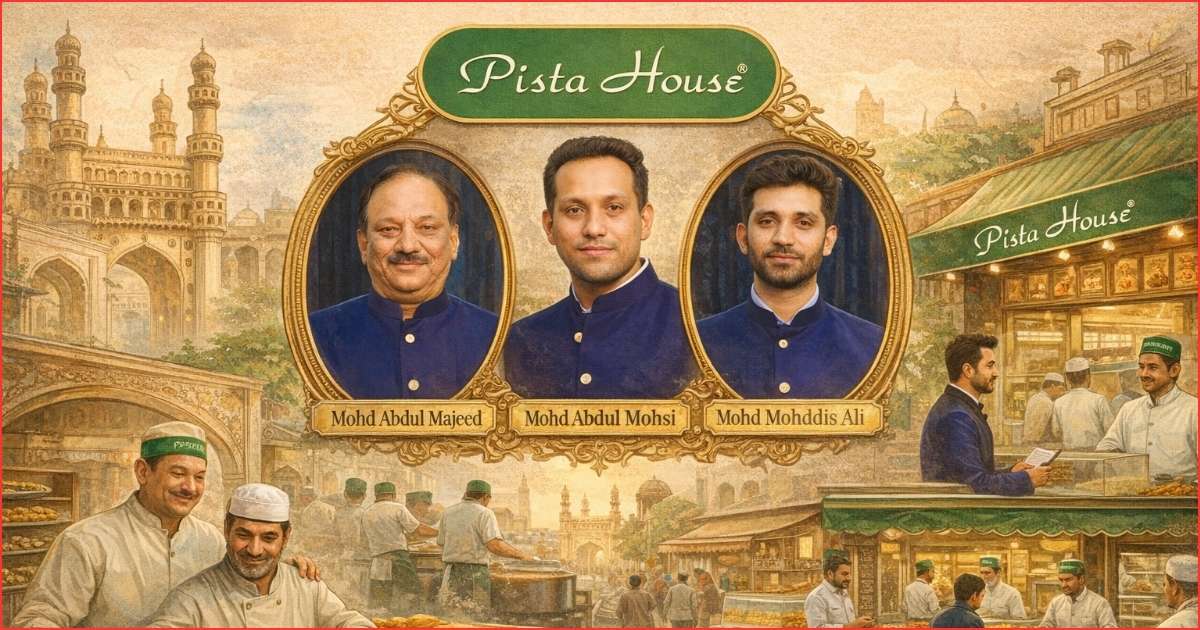
Hyderabad: The enduring success of Pista House has been driven by its strong family-led structure, which shaped its growth while preserving its culinary identity.
The brand began as a small bakery near Charminar, where family members handled daily operations. They supervised preparation and interacted directly with customers. This close involvement helped them understand customer expectations, evolving tastes and the importance of consistency.
Over time, this early engagement laid the foundation for the Pista House family legacy. It ensured that decisions remained rooted in real customer experience rather than abstraction.
As Hyderabad expanded, the business entered a new phase. The second generation took charge during a period of rapid urban change. New neighbourhoods emerged, food habits shifted and competition increased. However, the challenge was not just expansion but protecting the brand’s identity.
Pista House family legacy guides expansion decisions
Family leadership played a decisive role in managing growth. Decisions on menu additions, outlet expansion and presentation followed a shared understanding of the brand’s values. This continuity ensured that scaling did not weaken its original character.
Moreover, structured systems were introduced without removing personal accountability. The Pista House family legacy remained visible in everyday operations, even as the organisation became more formal.
Another key factor was the transfer of culinary philosophy. The focus extended beyond fixed recipes. Instead, emphasis was placed on understanding flavours, textures and preparation methods. This approach ensured that new team members aligned with the brand’s standards.
As a result, consistency remained intact despite expansion. The Pista House family legacy thus became a guiding principle rather than a symbolic idea.
Workforce continuity strengthens Pista House family legacy
The family’s approach also influenced workforce relations. Many employees stayed long-term, creating stability across kitchens and outlets. This continuity helped preserve cooking techniques and service patterns.
Customers experienced familiarity through both taste and service. They recognised not just dishes but also staff and routines. This consistency strengthened trust in the brand.
When the company expanded beyond Hyderabad, the same values guided decision-making. New markets brought challenges, yet the core philosophy remained unchanged. The focus stayed on representing Hyderabadi cuisine authentically.
At the same time, innovation was not ignored. The brand adopted changes cautiously. Each addition was evaluated to ensure it complemented tradition rather than disrupted it.
Consequently, the Pista House family legacy balanced continuity with adaptation. It allowed the brand to evolve without losing credibility among loyal customers.
In a competitive food industry, this approach has proven effective. Many brands struggle to maintain identity during rapid expansion. However, Pista House sustained both growth and authenticity.
The Pista House legacy continues to anchor its journey. It reflects a model where food is treated as heritage and business as responsibility. This framework has ensured long-term stability while allowing measured progress.