
Asaduddin Owaisi is diverting Muslims from the vote chori campaign, says Sameer Waliullah Waliullah

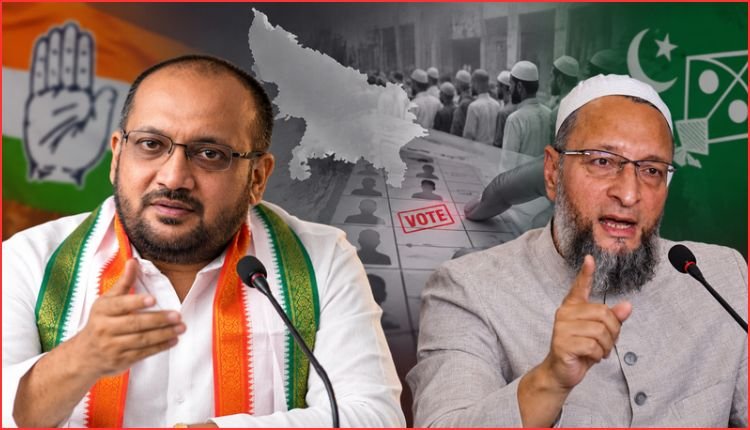
Hyderabad: Congress leader Mohammed Waliullah Sameer on Tuesday accused AIMIM president Asaduddin Owaisi of diverting Muslim voters from Rahul Gandhi’s nationwide vote chori campaign. He alleged that Owaisi was shifting attention from electoral roll irregularities towards the question of independent Muslim political leadership.
Sameer, the Congress in-charge of the Hyderabad Lok Sabha constituency and former DCC president, questioned Owaisi’s recent political speeches in Uttar Pradesh. He said the AIMIM president’s intervention came when Rahul Gandhi was raising concerns over the protection of voting rights across communities.
Owaisi had recently addressed gatherings in Azamgarh and Rampur, urging Muslims to develop their own political leadership. He had asked them to move away from dependence on Gandhi-Nehru or Yadav leadership. However, Sameer argued that the immediate concern should be protecting the electoral rights of eligible citizens.
“At a time when Rahul Gandhi is asking whether every eligible citizen’s vote is safe, Owaisi wants Muslims to debate who their leader should be. If your name itself disappears from the voter list, what meaning does any debate over leadership have? The first battle is to protect the vote,” he said.
Congress leader questions AIMIM’s role in vote chori campaign
Sameer said the vote chori campaign addressed alleged irregularities in electoral rolls that could affect voters from every community. He accused Owaisi of narrowing the political discussion to Muslim leadership rather than addressing the wider electoral issue.
According to Sameer, alleged wrongful deletion, exclusion or manipulation of names from voter lists required attention beyond community-based politics. He also distinguished between alleged electoral roll irregularities and what he described as vote katwa politics.
“First, there is the danger of vote chori through alleged irregularities in electoral rolls. Then there is vote katwa politics after voters reach the polling booth. Muslims must understand both,” he said.
He maintained that Rahul Gandhi was treating electoral roll concerns as a national democratic issue. Meanwhile, he alleged that Owaisi’s emphasis on separate Muslim leadership was drawing attention away from those concerns.
Sameer cites AIMIM’s performance in the 2022 UP elections
Sameer also questioned AIMIM’s electoral strategy, citing its performance in the 2022 Uttar Pradesh Assembly elections. He pointed to five constituencies where AIMIM’s vote tally exceeded the BJP’s victory margin over the Samajwadi Party or its allies.
In Nakur, the BJP won by 155 votes, while AIMIM secured 3,591 votes. Similarly, in Kursi, the BJP’s victory margin stood at 520 votes, against AIMIM’s tally of 8,541. In Bijnor, the BJP won by 1,445 votes, while AIMIM polled 2,290 votes.
The BJP also secured Sultanpur by 1,388 votes, while AIMIM received 5,251 votes. In Aurai, the BJP’s victory margin was 1,647 votes, compared with AIMIM’s 2,190 votes. Sameer argued that these figures warranted scrutiny of AIMIM’s electoral impact in closely contested constituencies.
“These figures are why the ‘vote katwa’ question cannot simply be dismissed as political propaganda,” he said. However, he acknowledged that AIMIM’s voters could not automatically be counted as supporters of the Samajwadi Party or other Opposition parties.
“But when AIMIM polls more votes than the BJP’s victory margin in several close contests, people have every right to question the political impact of its intervention,” he said. The figures alone do not establish how those voters would have voted without AIMIM candidates.
Sameer said AIMIM had the democratic right to contest elections. However, he maintained that its electoral strategy remained open to scrutiny. He raised these concerns ahead of the 2027 Uttar Pradesh Assembly elections.
“No one is denying AIMIM its right to contest. The question is who ultimately benefits when votes opposed to the BJP get divided in a closely fought election,” he said. Sameer also questioned whether AIMIM’s Uttar Pradesh campaign primarily sought to challenge the BJP or expand its own electoral presence.
He alleged that such expansion could come at the expense of Congress, the Samajwadi Party and other Opposition parties. According to him, the political consequences of AIMIM’s participation deserved examination, particularly in constituencies decided by narrow margins.
Sameer raises questions over Muslim representation and political alliances
The Congress leader said greater Muslim representation in elected bodies and political organisations was necessary. He called for more Muslim MPs, MLAs, ministers, mayors, councillors and party office-bearers.
However, he argued that political representation should not be confused with isolation from broader alliances. “Representation and isolation are two different things. A strong Muslim leadership should be able to shape wider democratic politics, not operate within a separate political enclosure,” he said.
Sameer maintained that increasing representation should not involve weakening political alliances or fragmenting votes in closely contested elections. He also questioned AIMIM’s internal organisational structure.
Despite maintaining its headquarters in Hyderabad, AIMIM did not have a separate Telangana state president, he claimed. He contrasted this with the party’s state-level organisational structures elsewhere.
“You cannot ask Muslims across India to stop depending on other leaders while your own organisation remains tightly controlled from the top. Independence must begin inside the party before it is preached outside,” he said.
Sameer alleges contradictions in AIMIM’s electoral messaging
Sameer further alleged that AIMIM adopted different approaches towards Muslim vote consolidation in Hyderabad and other states. He said the party warned Muslim voters in Hyderabad that divided votes could benefit the BJP.
However, he alleged that AIMIM encouraged Muslim voters in Uttar Pradesh, Bihar and elsewhere to move away from established Opposition parties. He specifically referred to Congress, the Samajwadi Party and the Rashtriya Janata Dal.
“Owaisi cannot preach consolidation in Hyderabad and fragmentation elsewhere without being questioned,” he said. Sameer asked Owaisi to clarify the principal objective of AIMIM’s political campaign in Uttar Pradesh.
He also reiterated his concerns about the impact of divided Opposition votes in closely contested elections. Sameer said Muslims needed both stronger political representation and protection against alleged irregularities affecting their voting rights.
He maintained that the vote chori campaign concerned the electoral rights of all communities rather than any particular religious group. He again questioned the timing of Owaisi’s campaign for independent Muslim political leadership.
“Rahul Gandhi is leading a national fight against alleged vote chori. Muslims need both representation and protection of their vote, but without the vote, representation itself becomes meaningless. The immediate priority should be to defeat vote chori, not create another round of vote katwa politics,” Sameer Waliullah said.