
KRMB cites legal constraints on stopping unapproved Krishna water projects

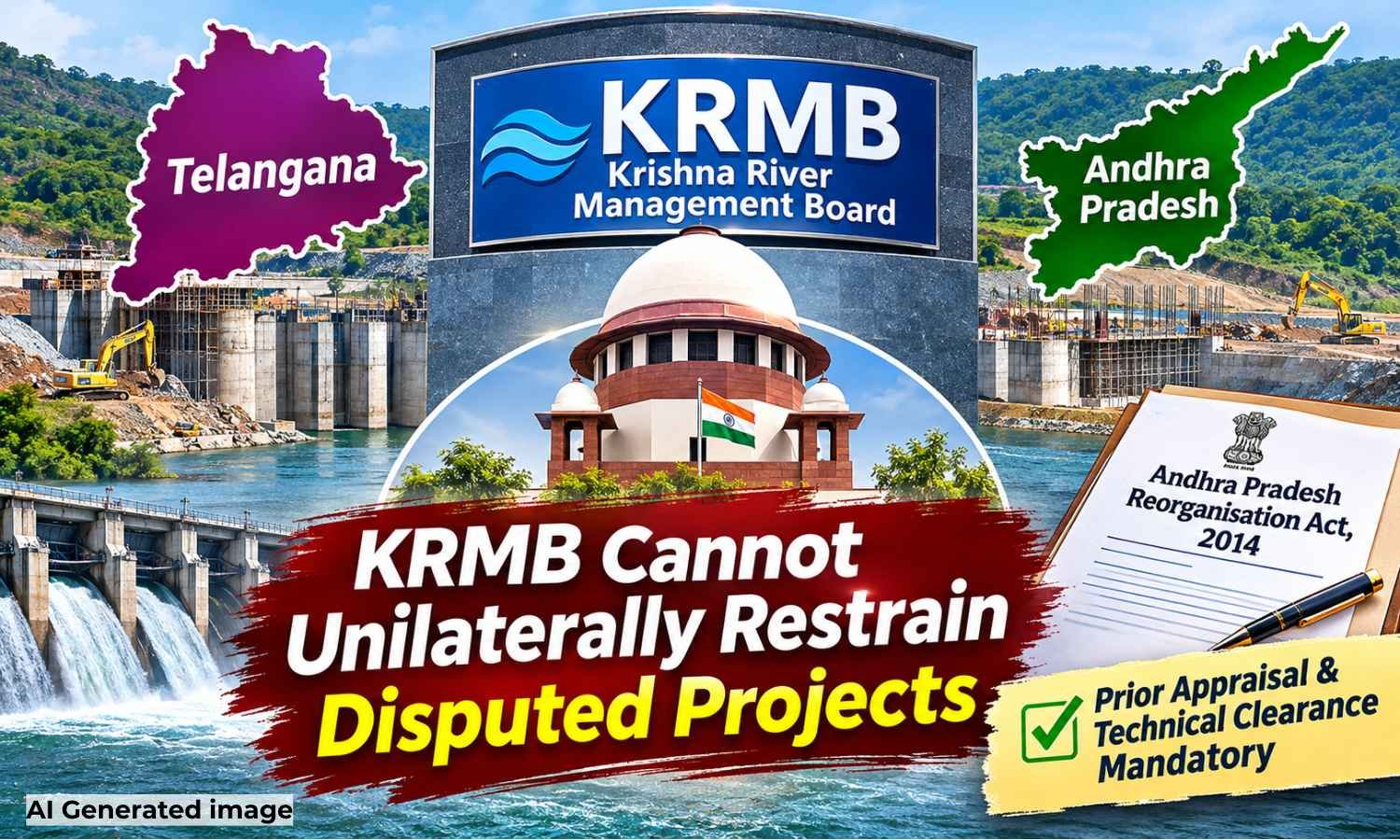
Hyderabad: The Krishna River Management Board (KRMB) has expressed its inability to unilaterally restrain the construction of disputed irrigation projects in Telangana and Andhra Pradesh, citing legal and procedural constraints arising from the pending Supreme Court proceedings and the requirement for consensus-based decisions. The Board has, however, reiterated that both States must obtain prior appraisal and technical clearance for new projects in accordance with the Andhra Pradesh Reorganisation Act, 2014.
In an official communication dated November 19, 2026, addressed to the Water Resources Department of Andhra Pradesh and the Irrigation and Command Area Development Department of Telangana, the KRMB Secretariat outlined its position on requests seeking intervention against unapproved projects. The letter followed communications received from Telangana on November 16 concerning the ongoing disputes over Krishna water projects.
The Board stated that similar requests seeking restrictions on construction activities by either State had been received on earlier occasions. It explained that its ability to issue directions restraining a State was limited by its jurisdictional framework and established decision-making procedures.
Telangana’s Supreme Court challenge complicates KRMB intervention
The KRMB pointed out that Telangana had challenged the Union Ministry of Jal Shakti’s 2021 jurisdiction notification before the Supreme Court through Writ Petition (Civil) No. 666/2024. Telangana had questioned the constitutional validity of the notification, alleging that it was beyond the powers conferred by the Constitution and amounted to an abuse of the Union Government’s authority.
The disputed notification defines the Board’s jurisdiction and functions, including its role in appraising projects under Section 85(8) of the Andhra Pradesh Reorganisation Act, 2014.
The KRMB observed that Telangana had sought the Board’s intervention while simultaneously challenging the notification defining its jurisdiction. It described the two positions as inherently contradictory.
The Board also referred to its decision-making procedure under Clause 6(iii) of the rules adopted at its 16th meeting. Under this provision, decisions are generally taken through consensus. Where consensus is absent, a contested matter remains inconclusive unless a dissenting view is specifically recorded for deferment under Clause 6(ii).
Consequently, the KRMB stated that its ability to decide disputed matters was constrained by the consensus requirement and further complicated by the pending legal challenge to its jurisdiction before the Supreme Court.
The communication also cited Principle 9 of the Eleventh Schedule to the Andhra Pradesh Reorganisation Act. This provision deals with consequential action by the Central Government when a State fails to implement a Board decision. The KRMB explained that invoking the provision presupposed a valid Board decision within its jurisdiction that had subsequently not been implemented.
Both States advised to obtain mandatory clearances
The KRMB reiterated that Telangana and Andhra Pradesh must comply with Principle 7 of the Eleventh Schedule to the Andhra Pradesh Reorganisation Act, which requires prior appraisal and technical clearance from the respective Board for new projects before sanction by the Apex Council.
It advised both States to follow the statutory approval process rather than proceed with projects based on assumptions about the availability of surplus or unallocated water.
The Board stated that the conception or construction of projects based on presumed water availability did not, by itself, create an assured or legally enforceable entitlement to utilise those waters.
It further clarified that project-wise water allocations would have to be determined by the competent tribunal. The communication was issued while the Krishna Water Disputes Tribunal-II award remained awaited.
The letter, issued with the approval of the KRMB Chairman, was digitally signed by Superintending Engineer-II Narani Venkata Raman on November 19.
The communication did not grant approval for any disputed project or issue directions suspending construction. Instead, the Board reiterated the statutory procedures applicable to both States and the legal limitations governing its intervention in interstate water disputes.