

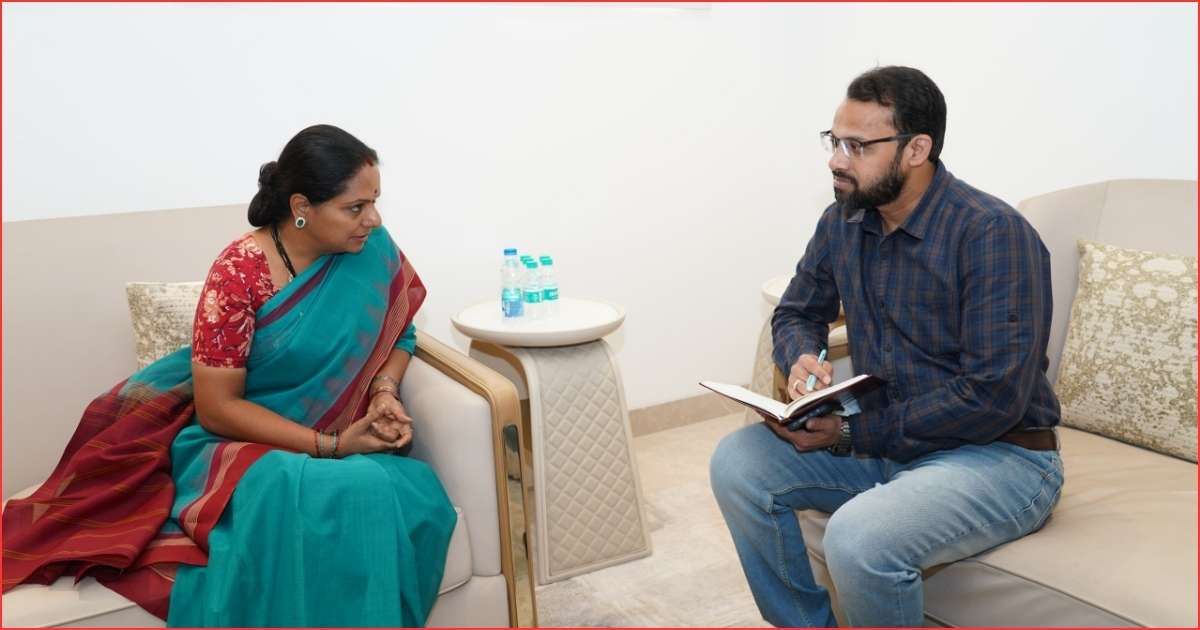
Hyderabad: Telangana Jagruthi president K. Kavitha said the Delhi liquor case against her formed part of a political attempt to weaken regional parties, according to a Kavitha interview conducted after a special court cleared her of charges.
The court recently acquitted Kavitha in the Delhi liquor policy case and criticised the Central Bureau of Investigation for lack of evidence. The same verdict also cleared former Delhi chief minister Arvind Kejriwal and minister Manish Sisodia after months of investigation into alleged irregularities in the excise policy.
In the Kavitha interview with senior journalist Sheikh Khalil Farhad, she alleged that the case reflected a broader political strategy. According to Kavitha, the Bharatiya Janata Party-led Union government aimed to weaken regional parties across the country.
Leaders who challenge that approach or raise questions about civil and personal rights often face pressure through investigations, she said.
Kavitha argued that several prominent leaders across states either withdrew from politics or eventually joined the BJP under similar circumstances. For that reason, she said the liquor case against her must be viewed within a larger political framework.
Kavitha interview and allegations of political targeting
During the Kavitha interview, she also addressed the reputational impact of corruption allegations.
Kavitha said accusations often damage public credibility even when courts later dismiss the charges. According to her, political rivals deliberately attach labels that remain in public memory.
She cited the example of Arvind Kejriwal, noting that a leader associated with anti-corruption politics later faced corruption allegations in the same case.
Similarly, Kavitha said her work promoting Telangana culture and the Bathukamma festival became overshadowed by the liquor case accusations.
Throughout the investigation, she maintained that the Delhi liquor policy case was fabricated. The court verdict, she said, validated that position.
Kavitha noted that the judgment cleared all accused and also questioned the investigation conducted by the CBI. The ruling, she added, also undermined attempts to link the allegations to her father, former Telangana chief minister K. Chandrashekar Rao, and the Bharat Rashtra Samithi party.
When asked about action against those who accused her, Kavitha said the court decision itself established the truth. Entering into political retaliation would not serve any purpose, she added.
According to Kavitha, authorities have already initiated a departmental inquiry against one investigating officer. She described that move as an unusual development in Indian legal history and argued that it exposed flaws in the investigation.
Kavitha interview describes Tihar jail experience
Kavitha also discussed her time in custody during the Kavitha interview.
Authorities first kept her for five days in Enforcement Directorate custody before transferring her to Tihar Jail in Delhi. Conditions in the ED facility differed sharply from those in the prison, she said.
Inside Tihar Jail, Kavitha encountered inmates from many social backgrounds. Several women remained in jail despite receiving bail because they could not pay the bond amount.
Two undertrial prisoners accused of murder shared her cell, she said.
Many inmates approached her with questions about their legal cases. Kavitha said she tried to guide them and arranged legal help whenever possible.
Prison authorities treated her like other inmates but maintained additional security arrangements.
Kavitha spent much of her time reading books and practising meditation. She said meditation had been part of her routine since childhood and helped her remain mentally stable.
Newspapers reached prisoners only after two months, she said. Even then, prison officials removed certain reports before distribution.
She recalled an incident involving about 20 to 25 young women who worked in the software sector. Police brought them to jail after investigators linked their employer to a fraud investigation in Thailand.
According to Kavitha, the young women had no direct role in the alleged offence. Prison staff later counselled them because they were frightened and distressed.
In another incident, a dispute between inmates turned violent when one prisoner threw hot water on another. Such outbursts reflected the extreme stress inside prisons, Kavitha said.
Kavitha interview reveals plans for new Telangana party
Reflecting on the case, Kavitha said the experience helped her identify genuine supporters.
During the investigation, she added, her former party Bharat Rashtra Samithi did not stand by her. The party eventually expelled her, which ended her association with it.
Kavitha confirmed in the Kavitha interview that she now plans to launch an independent regional political party in Telangana.
Major political parties in the state including the BJP, Congress and BRS operate largely with national agendas, she argued. Telangana therefore needs a party focused exclusively on the state’s interests.
Preparations for the new organisation are already underway. Kavitha said she expects to launch the party within two months.
Receiving a clean chit before the launch strengthened her resolve and provided political momentum, she said.
At the end of the Kavitha interview, she credited her husband Anil Kumar as her strongest support during the legal battle.
He spent most of his time in Delhi coordinating with lawyers and preparing for court hearings while she remained in jail.
The situation placed heavy strain on their family. During that period, her parents-in-law stayed with the children while both parents dealt with the case.
Media speculation suggested the legal battle could last years, she said. However, the court verdict eventually ended that uncertainty.
Kavitha said the experience reinforced her belief that legal challenges may take time but truth ultimately prevails.
The political platform she plans to launch in Telangana will focus on transparency and grassroots engagement in public life, she added.