
Collective push needed to make Indian turmeric globally competitive: Tummala

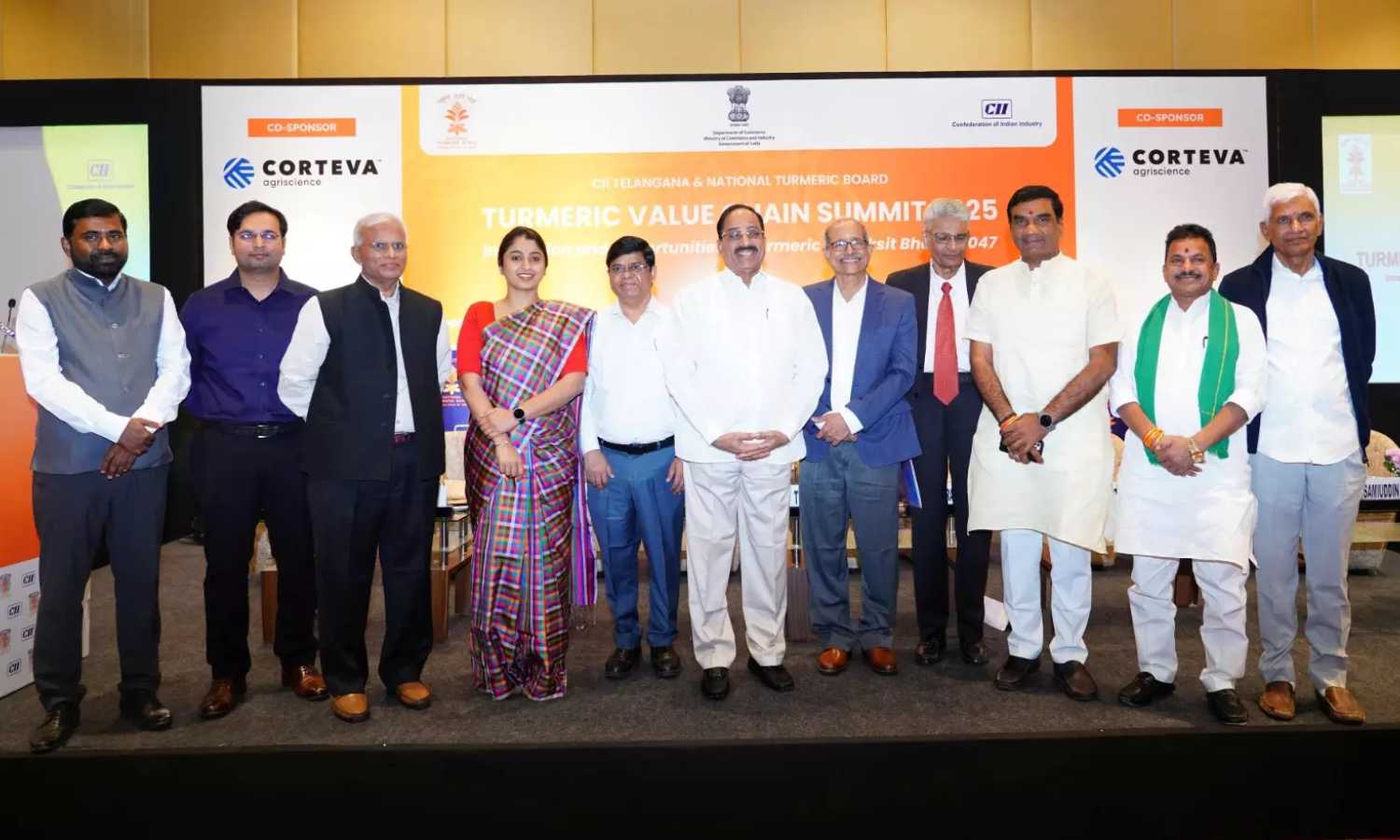
Hyderabad: Minister for Agriculture Tummala Nageswara Rao on Wednesday called for collective action to make Indian turmeric globally competitive. Speaking at the Turmeric Value Chain Summit 2025 in Hyderabad, he said both policy leadership and market readiness are essential for India’s turmeric sector to thrive internationally.
The summit was jointly organised by CII Telangana and the National Turmeric Board. Tummala emphasised the need to support turmeric farmers through price stability, value addition, and enhanced branding. “We must think beyond subsidies and start focusing on positioning agriculture – and turmeric – as economic growth drivers,” he said.
He recalled the launch of Agri Vision 2047 at the Telangana Rising Global Summit, describing it as a blueprint to shift agriculture from a welfare model to a revenue engine. Turmeric, he noted, was an important part of that roadmap.
The Minister urged the National Turmeric Board to function actively in the field. “It should not just be an office. It must guide farmers, push research into farms, and lead on marketing, branding, and export policy,” he said. He also raised concerns over reduced turmeric cultivation in Telangana due to volatile prices. Farmers are spending ₹8,000–9,000 per quintal but earning only around ₹12,000, he pointed out.
National Turmeric Board urged to lead efforts for Indian turmeric to be globally competitive
Tummala called on the board to align with Agri Vision 2047 and deliver price signals and stability to help farmers plan better. “We must secure their income if we want them to continue turmeric cultivation,” he said.
National Turmeric Board chairman Palle Ganga Reddy stated that turmeric is the only spice with a dedicated board in India. He noted it is cultivated on around eight lakh acres, with Telangana contributing nearly 60,000 acres. He emphasised the need for scientific studies, quality standards, and better infrastructure at key turmeric markets like Nizamabad.
Agriculture Secretary K. Surendra Mohan said Telangana produces nearly 10% of the global turmeric supply and involves over 40,000 farmers. He highlighted the importance of farmer-producer organisations (FPOs), organic farming, and processing units to boost export value.
More than 200 stakeholders, including officials, exporters, farmers, and industry representatives, attended the summit.