

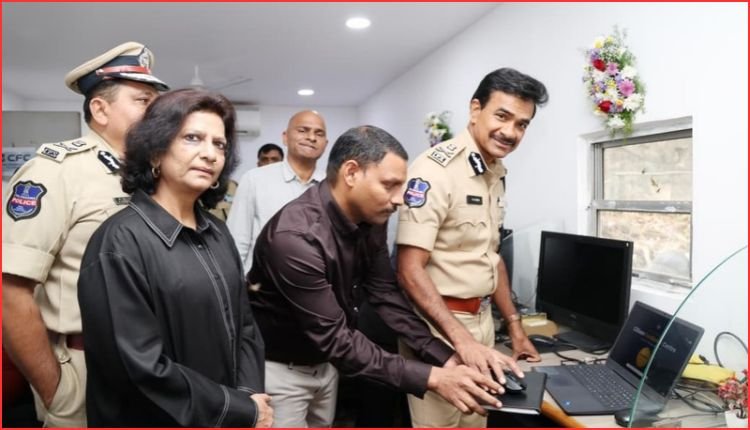
Hyderabad: Telangana Director General of Police C.V. Anand on Wednesday launched seven digital policing services developed by the Criminal Investigation Department (CID). The initiatives aimed to improve crime investigations, strengthen public accountability and increase operational efficiency across the state police.
The newly introduced systems included citizen feedback facilities, digital monitoring of Bharosa Centres, prisoner release alerts and facial recognition technology.
Additionally, the CID introduced a mobile fingerprint identification application, a public information website and five volumes of investigation procedures. Officials said the initiatives would improve coordination between police units and provide investigators with faster access to information.
Seven digital policing services include citizen feedback and victim support systems
The Citizen Feedback Centre will collect public responses about police services and help authorities assess service delivery. Meanwhile, the CID introduced a unified software platform to monitor the functioning of 35 Bharosa Centres across Telangana.
The platform will maintain digital records of counselling, medical assistance, legal support and rehabilitation services provided to victims. It will also allow officials to track these services throughout the case, from initial registration to its conclusion.
Previously maintained paper registers will give way to digital records, state-level dashboards and 23 categories of online reports. The system aims to improve monitoring and coordination among officials responsible for victim assistance.
The CID also launched its official website to provide public access to information about departmental activities and services. Citizens can access the website at [cid.tspolice.gov.in](https://cid.tspolice.gov.in/).
Prisoner release alerts integrated with national databases
Another initiative was the Jail Release Monitoring System, which connects prison records with existing police databases. The CID integrated the system with the National Informatics Centre’s e-Prisons platform and the Crime and Criminal Tracking Network and Systems (CCTNS).
Under the arrangement, police stations and concerned officers will receive SMS alerts about prisoners’ release from jail. The system will also support criminal analysis by linking release information with available crime records.
Officials said the integration would strengthen information sharing between prison authorities and police units. The CID also introduced a mobile face-search application containing more than 9.8 lakh photographs.
According to officials, the application can match facial images in approximately 15 seconds. Investigators can use the technology to help identify crime suspects, missing persons, unidentified bodies and deceased individuals.
The application provides another digital identification tool for police personnel handling criminal investigations and missing-person cases. The Crime Scene Chance Print application was another technology initiative launched by the Telangana Police.
The application allows investigators to capture fingerprints collected at crime scenes using Android mobile phones. Officers can then transmit the fingerprint information to a state server for automated matching.
Officials described the initiative as the first system of its kind introduced in India. The technology is intended to support fingerprint identification and improve the use of forensic evidence during investigations.
Five SOP volumes prepared to strengthen investigations
Alongside the technology initiatives, the CID prepared five volumes of Standard Operating Procedures (SOPs) covering different categories of criminal offences. The procedures address physical crimes, property offences, crimes against women and children, violations of special and local laws, and other criminal cases.
The documents aim to standardise investigative practices and improve the quality of evidence collection and case preparation. Officials said the procedures would also help strengthen prosecution by improving the investigation process.
The seven digital policing services and accompanying investigation procedures formed part of the CID’s efforts to modernise police operations. According to officials, the systems would improve transparency, strengthen coordination and support crime prevention and investigation across Telangana.