

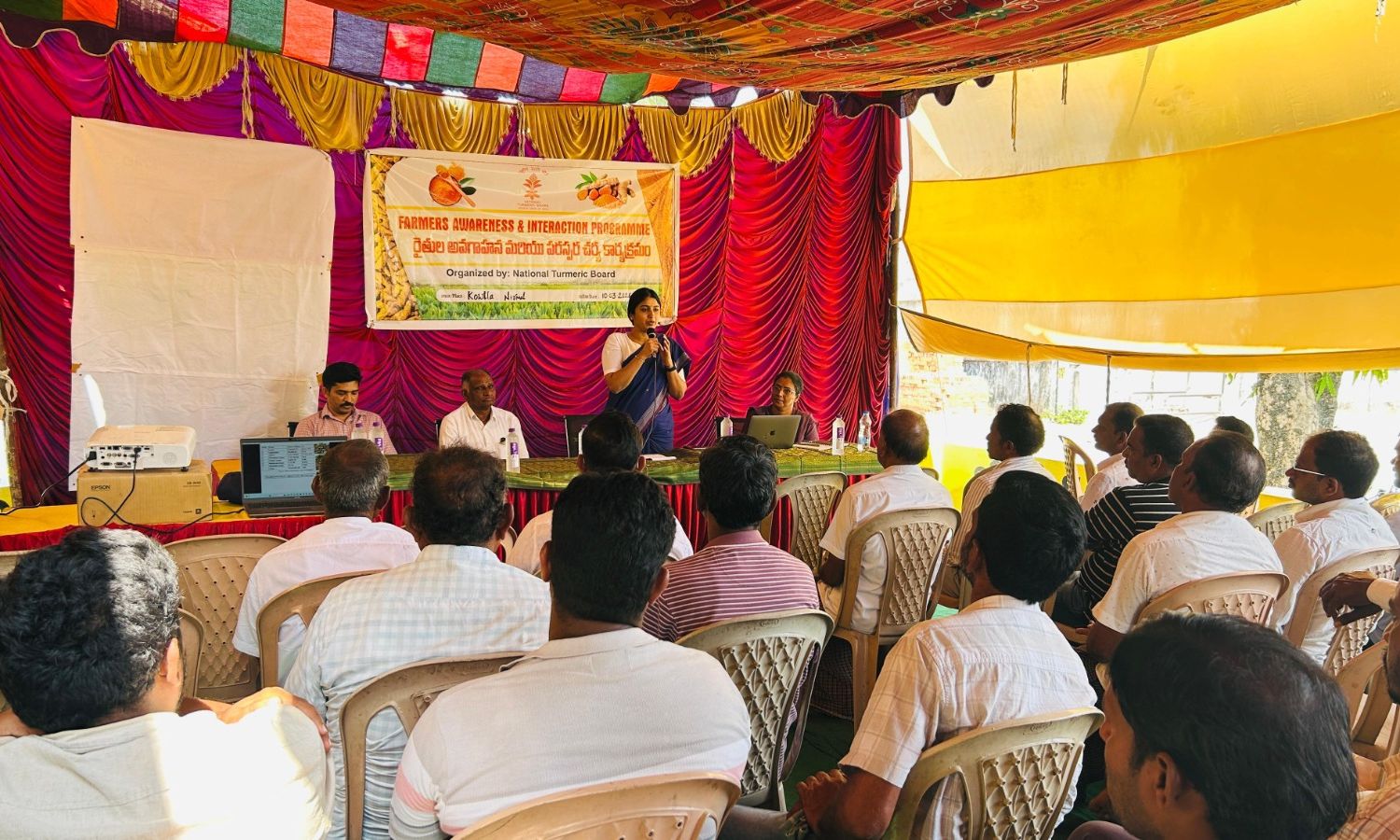
Hyderabad: The National Turmeric Board has launched a farmer awareness programme in Nirmal district to promote scientific cultivation practices aimed at strengthening turmeric exports promotion.
The programme focused on Integrated Pest Management (IPM) practices that help reduce pesticide residue levels and improve the quality of turmeric grown for international markets. More than 100 farmers and several Farmer Producer Organisations participated in the training session.
Addressing the gathering, Board Secretary N. Bhavani Sri said global markets such as the European Union, the United States, the United Kingdom, Japan and Korea maintain strict limits on pesticide residues and contaminants. Therefore, farmers must adopt scientific cultivation practices to meet export standards.
During the programme, farmers received training on biological and botanical pest-control techniques designed to minimise chemical pesticide use in turmeric cultivation.
Turmeric exports promotion through IPM and quality control
Officials explained that the turmeric exports promotion initiative encourages farmers to use eco-friendly crop protection methods. These include Trichoderma viride, Pseudomonas fluorescens, pheromone traps and neem-based formulations to control diseases such as rhizome rot.
The Board also emphasised the importance of Good Agricultural Practices to ensure export-quality produce. Farmers were advised to adopt proper drying methods and moisture management techniques to prevent aflatoxin and microbial contamination that could result in export rejection.
According to officials, India exported around 1.76 lakh metric tonnes of turmeric worth $341.54 million during 2024–25. Improving farm-level practices and strengthening traceability systems will be crucial to expanding these exports further.
As part of the initiative, the National Turmeric Board plans to extend the programme to nearly 200 acres in Nirmal district in collaboration with Farmer Producer Organisations. The goal is to promote residue-free and organic turmeric cultivation that meets international export requirements.