

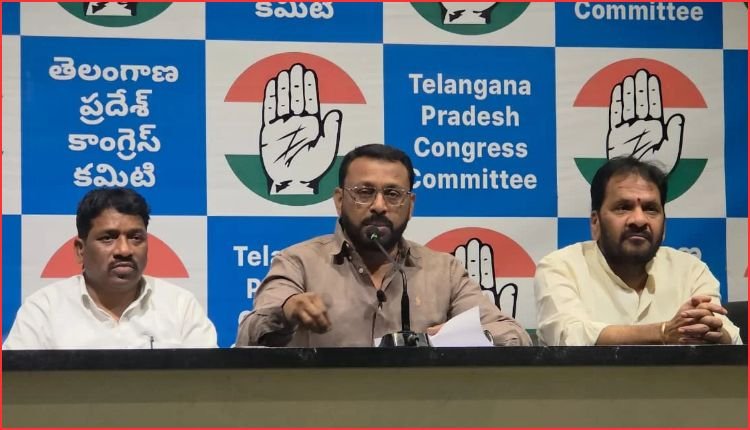
Hyderabad: Telangana Pradesh Congress Committee (TPCC) spokesperson Syed Nizamuddin on Monday accused the BRS of politicising the emerging El Niño water crisis in Telangana. He alleged that the opposition party was exploiting rainfall shortages for political gains instead of supporting measures to protect farmers, workers and drinking water supplies.
Addressing a press conference at Gandhi Bhavan on October 26, Nizamuddin said deficient rainfall, falling reservoir levels and increasing groundwater dependence had created serious concerns. However, he maintained that climatic conditions, rather than government decisions, had caused the situation.
“At a time when the State needs cooperation, the BRS is trying to create a political controversy. It has every right to question implementation, but it should not mislead people about the cause of the crisis,” Nizamuddin said.
El Niño water crisis raises concerns over rainfall deficit
Telangana received 615.5 mm of rainfall during the southwest monsoon from June to September, against the normal 740.6 mm. This represented a deficit of approximately 17%. Several districts recorded larger shortfalls, while many areas also experienced exceptionally dry conditions during October.
Nizamuddin said the rainfall shortage had increased pressure on reservoirs, tanks and groundwater sources. Consequently, advance planning had become essential to manage drinking water, agriculture and electricity requirements.
He also cautioned against exaggerated claims about El Niño, describing it as a recurring climatic phenomenon with varying effects. According to him, the BRS was creating fear and confusion instead of supporting coordinated preparations.
Government outlines measures to address El Niño water crisis
Nizamuddin said Chief Minister A. Revanth Reddy had been personally reviewing drinking water availability, agricultural requirements, electricity demand, rural employment and urban water management.
The government had constituted a Cabinet sub-committee headed by Deputy Chief Minister Mallu Bhatti Vikramarka to monitor developments continuously. Additionally, authorities had appointed a nodal officer to strengthen interdepartmental coordination and provide accurate public information.
Nizamuddin said the arrangements would help counter rumours and prevent unnecessary anxiety. He maintained that the government had approached the situation as a broader economic and environmental challenge rather than an irrigation problem alone.
The Congress government proposed a special employment programme covering four months after Sankranti until the end of May. Nizamuddin said agricultural activity could decline in water-stressed areas, affecting rural labourers and financially vulnerable households.
The proposed programme would combine funding available under Central schemes with additional State government support. Its objective was to provide employment opportunities and protect rural incomes during periods of reduced agricultural activity.
Meanwhile, public representatives had been instructed to maintain close contact with villages over four months. They would identify local difficulties, coordinate with officials and facilitate assistance to affected families.
Nizamuddin said these measures would help address livelihood concerns alongside water shortages. The TPCC spokesperson said the government had advised farmers to consider rainfed crops and vegetables wherever conditions permitted.
Authorities also recommended avoiding water-intensive cultivation in areas without assured irrigation facilities. In particular, farmers in vulnerable areas had been advised against cultivating paddy during the Rabi season.
Nizamuddin said the advisory aimed to prevent farmers from investing heavily in crops that might subsequently fail because of inadequate water. “It is better to guide farmers in advance than allow them to invest heavily and face crop failure later. This is responsible planning, not panic,” he said.
He added that early crop planning would help farmers manage risks arising from uncertain water availability. Nizamuddin said drinking water remained the government’s highest priority amid declining storage in several major reservoirs.
He claimed that some reservoirs held substantially less water than during the corresponding period last year. Several minor irrigation sources were also experiencing pressure.
At the same time, electricity demand had increased as farmers relied more heavily on borewells and agricultural pump sets. Therefore, he emphasised the need to conserve both water and electricity.
“The government alone cannot handle a climate-related crisis. Public cooperation is equally important,” he said. He also supported the Chief Minister’s appeal for public participation in conservation measures.
Hyderabad to launch Green Water tanker initiative on November 1
Nizamuddin referred to the Hyderabad Metropolitan Water Supply and Sewerage Board’s proposed Green Water tanker initiative. The programme was scheduled to begin on November 1.
Under the initiative, GPS-tracked tankers would transport treated wastewater from sewage treatment plants for non-drinking purposes. The intended uses included construction, industrial operations, parks, greenery maintenance, road cleaning and dust control.
The system would provide online registration, tanker booking, digital payments and delivery confirmation. Additionally, filling stations would have electronic point-of-sale facilities. Nizamuddin said the initiative could reduce dependence on drinking water and fresh groundwater for activities where treated wastewater was suitable.
“There is no reason to use drinking water or extract fresh groundwater for activities where treated water can be safely used. This will reduce pressure on Hyderabad’s drinking water sources and groundwater,” he said.
TPCC challenges BRS over El Niño water crisis response
Nizamuddin claimed that Telangana had begun preparing for possible water shortages months earlier. According to him, the government conducted expert consultations, prepared contingency plans and repeatedly reviewed agricultural, water and electricity requirements.
He argued that these measures demonstrated advance preparation rather than a delayed response. However, he alleged that the BRS was overlooking government initiatives to sustain its political criticism. The opposition party had every right to question implementation shortcomings, he said. Nevertheless, it should also present alternative proposals.
“If the BRS has a better plan, it should place it before the people. But blaming the government for a rainfall deficit is political opportunism. This is the time to support conservation, crop planning, rural employment and drinking water management,” he said.
Nizamuddin urged residents to follow official information concerning water availability, agricultural advisories and government assistance. He also called for cooperation from farmers, industries and public representatives during the coming months.
“The focus should be on protecting farmers, workers and drinking water supplies. Telangana can minimise the hardship if the government and people work together. A crisis caused by nature should not be turned into a political battlefield,” Nizamuddin said.