

Hyderabad: Telangana expanded its welfare framework with new and existing schemes, including a life insurance cover for over 1 crore families, Finance Minister Bhatti Vikramarka Mallu said in the Budget.
The Telangana welfare schemes remained a central pillar of governance. The government said these measures aimed to reduce financial stress on households. It also focused on improving access to essential services and raising living standards.
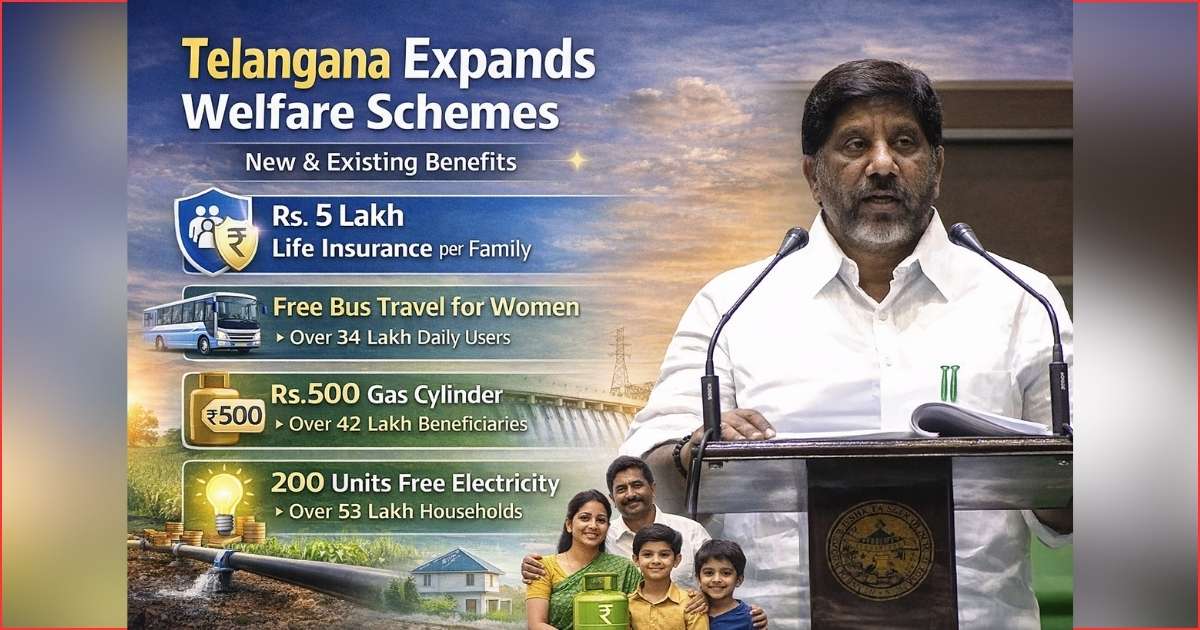
A key announcement was the Indiramma Family Life Insurance Scheme. Under this, each family will receive insurance coverage of Rs.5 lakh. The scheme will be implemented from June 2, 2026, and will cover about 1.15 crore families across the State.
The government described this as a major social security intervention. It said the scheme would protect families from financial distress after the death of an earning member. It also clarified that the coverage would apply across all sections without discrimination.
Telangana welfare schemes strengthen core benefits
The Telangana welfare schemes also continued major initiatives under the Abhaya Hastham framework. These included the Mahalakshmi scheme, which offers free bus travel for women across the State.
According to the government, nearly 34 lakh women used free bus services daily. A total of 269 crore journeys have been recorded so far. This resulted in savings of around Rs.9,222 crore for women, significantly reducing their travel expenses.
The subsidised LPG scheme also continued under the welfare framework. Gas cylinders were provided at Rs.500 to more than 42 lakh families. The government said this resulted in savings of about Rs.752 crore for beneficiaries.
Under the Gruhajyothi scheme, free electricity up to 200 units was provided to over 53 lakh households. The State bore a subsidy burden exceeding Rs.3,900 crore to sustain this scheme. The government said this support ensured energy access for low-income households.
Telangana welfare schemes deepen coverage across sectors
The Telangana welfare schemes also expanded pension coverage under the Cheyutha programme. The government sanctioned two lakh new pensions for eligible beneficiaries. This step aimed to provide financial support to vulnerable groups, including the elderly and disadvantaged sections.
Women’s empowerment remained a major focus area. The Mahila Shakti Mission aimed to make one crore women financially independent. The government facilitated bank loans worth Rs.57,938 crore to self-help groups to support their economic activities.
In addition, interest subsidies were provided to ease repayment burdens. Women’s groups were also encouraged to take up business opportunities. These included running retail outlets, operating petrol bunks and leasing buses to the State transport corporation.
Telangana welfare schemes expand housing and social support
Housing support continued under the Indiramma Illu scheme. Financial assistance of Rs.5 lakh was provided for the construction of houses for the poor. The government sanctioned 4.5 lakh houses under the scheme, with a total estimated cost of Rs.22,500 crore.
The budget also included targeted welfare measures for children and senior citizens. Anganwadi-cum-creche centres were expanded to improve childcare support. Nutrition programmes were strengthened to address health needs among children.
Support for differently-abled persons was also enhanced. The government said it aimed to improve accessibility and provide targeted assistance for their welfare and inclusion.
The Finance Minister stated that welfare expenditure should be seen as an investment in human development. He said the government aimed to ensure that no family was deprived of basic needs such as food, housing, electricity and healthcare.
He added that the integration of subsidies, direct benefit schemes and livelihood programmes would create long-term social and economic stability. The government maintained that these initiatives would improve quality of life across all sections.
Overall, the Telangana welfare schemes reflected a comprehensive and expanded social security framework. The approach combined direct financial support, subsidies and livelihood opportunities to ensure inclusive development.