
Priorities, Sustainability and Impact: Telangana Budget 2026–27
Dr. Tamma Koti Reddy

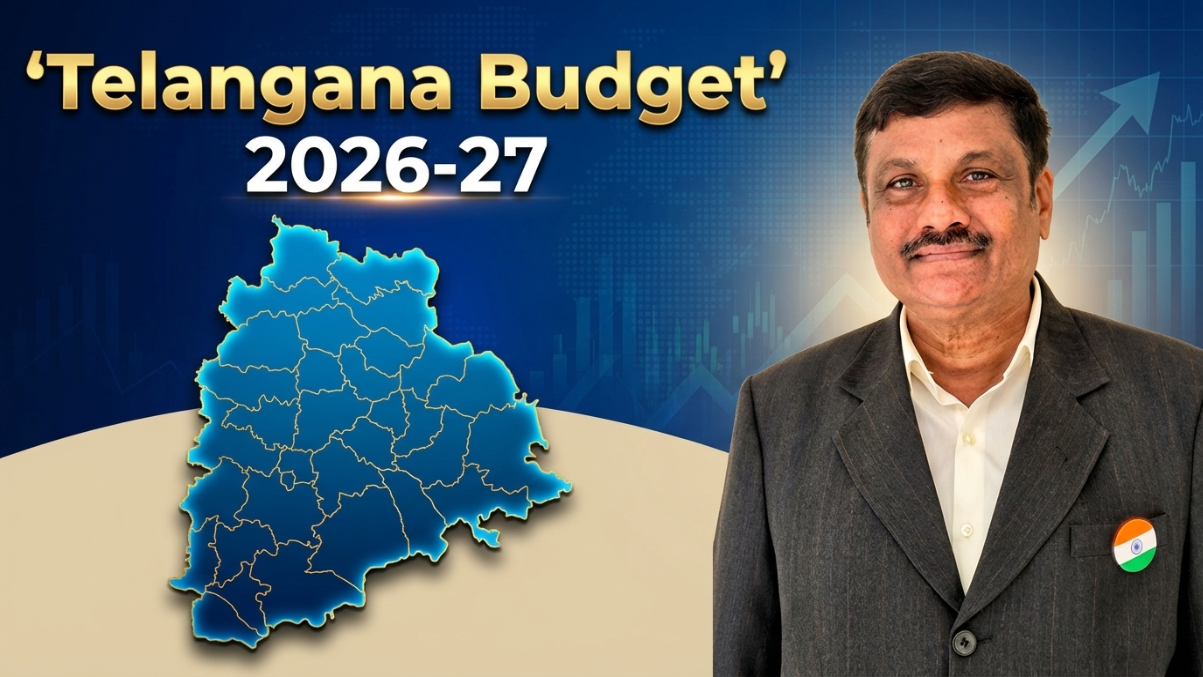
Hyderabad: The Telangana State Budget 2026-27, which was introduced in the Legislative Assembly on March 20, shows that the government is struggling to balance its welfare commitments with development-oriented investments. The budget can only be judged meaningfully on three issues namely; the policy priorities that the budget establishes, the sustainability of the fiscal framework and whether or not the budget has the potential influence on the state and national economy. At the priorities level, the budget emphasizes a twofold strategy, which is to strengthen social welfare and still make investments in growth-motivated sectors. Significant investments have been undertaken in the areas which have the direct impact on human development especially in education and healthcare. Such investments are important not only to enhance social outcomes but also to develop human resources to achieve long-term economic growth.
In addition to human development, the government has given a focus to agriculture, irrigation, energy, urban infrastructure and rural development. One of such large elements of the budget is the distribution of 50713 crore to carry out the six guarantees made during the 2024 elections in the State Assembly. It is hoped that these programmes will reinforce the social protection system and also serve the interests of the vulnerable groups in society. The budget is also focused on the inclusive development by raising the levels of allocations to the welfare of Scheduled Castes, Scheduled Tribes, Backward Classes and minority communities. The increase in expenditure on agriculture and irrigation is a demonstration of the determination by the state to boost the farm income, enhance food security and irrigation facilities. Panchayat Raj institution and rural development are investments directed towards enhancing connectivity and infrastructure development in the rural regions.
The energy sector has also been assigned Rs.21, 285 crore to be used not only to finance both welfare-oriented electricity generation initiatives, but also to spur investments in renewable energy and to facilitate a slow but steady shift to green energy. Moreover, job creation and skills training are other notable policy spheres that can be used to meet the expectations of the increasing number of youths in the state. Nevertheless, over and above priorities, the viability of the fiscal structure is also a vital factor to consider.
Fiscal sustainability concerns in Telangana Budget
The term fiscal sustainability means that a government can be able to sustain the public services as well as developmental spending without imposing undue financial burden in the future. The movement of the revenue, expenditure and public debt, in this respect, is of particular interest. The revenue receipts in Telangana have grown by a great deal since the state was established. Since 2014-15, they have almost four-folds which is an indication of a rising economic foundation of the state. The own tax revenue of the state, which is the foundation of the revenue structure, is expected to rise from Rs.29,288 crore in 2014-15 to Rs.148185 crore in 2026-27(BE).
Yet certain concerns remain. The revenue goals established in the 2025-26 budget were not completely achieved and approximately 70 per cent of the budgeted revenue is only collected by January 2026. Simultaneously, the proportion of central transfers in the revenue receipts -has decreased over the years since 2014-15 to almost 20 per cent. Such developments suggest that there is the need to mobilize more revenue and better fiscal management.
The other concern is associated with the structure of the revenue expenditure. Revenue expenditure has grown very high and currently it constitutes approximately three-fourths of total expenditure. As much as the government needs to spend on welfare, too much revenue spending can make the government impotent to invest in productive assets that yield long-term economic returns.
Capital Expenditure: This is the expenditure on infrastructure and asset development and it has been fluctuating over the years. Still, it contributed 5.59 per cent to GSDP in 2016-17 but has gone down in the following budgets, only beginning to improve during recent years. In the recent budget, the capital expenditure has been seen to go up to 47,267 crore in the 2026-27(BE), as it has some major irrigation and infrastructure projects. The Hyderabad Metro Rail expansion, the Future City project and the Musi River rejuvenation programme which have not been accorded the anticipated funding. The Union government should offer more assistance to see the boost in the development of such projects, as they are significant to urban development and economic growth. Another area that should be keenly monitored is the debt position of the state.
The state of Telangana has an estimated debt of Rs.5.62 lakh crore and the government intends to borrow Rs. 73383 crore in the financial year that starts next year. Although the fiscal deficit is still within the range that is stipulated in Fiscal Responsibility and Budget Management (FRBM) framework, the increasing debt levels emphasize the significance of fiscal management. The borrowed resources should be therefore channeled to productive investments yielding economic returns. It is necessary in completing outstanding irrigation projects and focus on economically viable infrastructure investments to ensure sustainability of growth over the long term.
Telangana’s
On a bigger scale, the budget also implies some nationwide impact on the economy. Telangana has become one of the rapidly expanding states in India, and its GSDP growth rate has been estimated at 10.7 per cent in 2025-26, which is quite high, compared to the national rate. The per capita income of the state is also almost twice of the national average, which is an indicator of good economic performance. But this trend can only be sustained with a sense of fiscal restraint.
An increase in welfare obligations and increasing debt obligations may cause macroeconomic stresses unless handled with caution. Enhanced revenue collection ,rationalization of subsidies and enhancement of the quality of public spending are the measures required to manage the public debt effectively. Telangana has already cemented itself as a big hub of pharmaceuticals, information technology and advanced manufacturing. Planned government investment in these areas can then invite further investment by the private enterprise, enhance exports and help India improving overall competitiveness of its industries.
The future envision of the state is demonstrated in the long-term ambition of the government to make the state the one trillion $ economy in 2036 and the three trillion $ economy in 2047. This will be attained through a long-lasting economic growth, good fiscal management and further investment in infrastructure and human capital. When properly balanced, the Telangana Budget 2026-27 will be able to do not just the development of the state but also the overall economic growth of the country.
[Dr Tamma Koti Reddy is the Vice Chancellor (Incharge), ICFAI Foundation for Higher Education (A Deemed to-be-University), Hyderabad]