

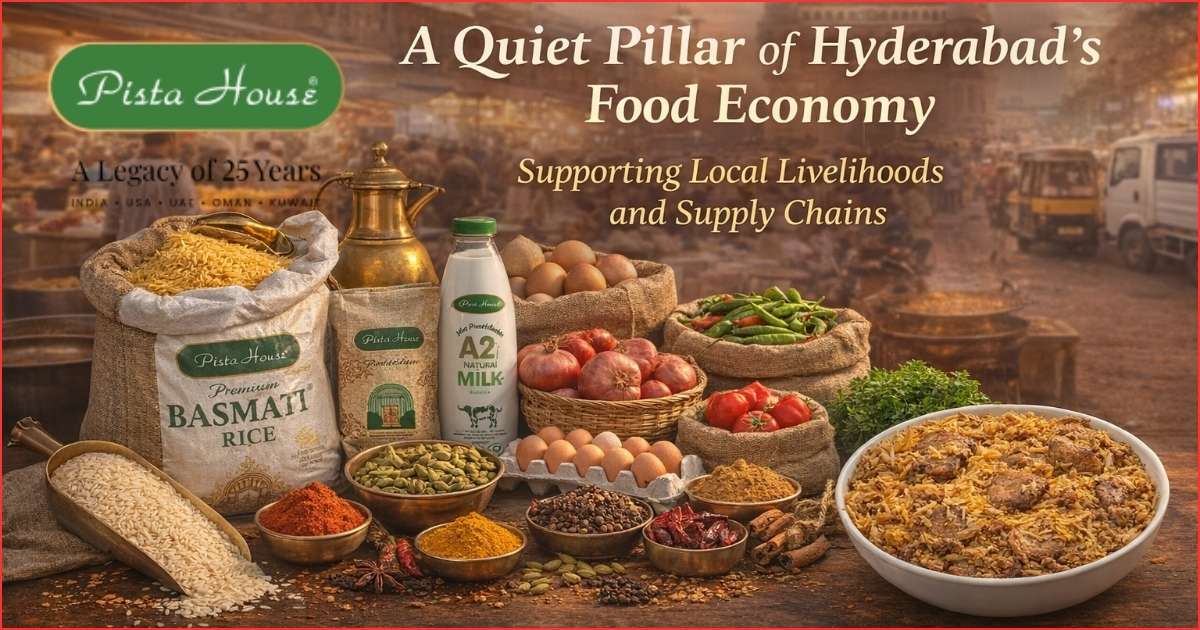
Hyderabad: Pista House food economy contributions have played a significant role in sustaining livelihoods and supporting Hyderabad’s wider food ecosystem over the years. The brand’s expansion has linked employment, supply chains and seasonal demand into a network that extends beyond its dining spaces.
At the operational level, the brand’s growth has created steady employment across multiple functions. Kitchens, bakeries, service counters, logistics units and administrative roles have formed a diverse workforce. For many employees, association with a long-standing local brand has provided stability in an industry often marked by high turnover. This continuity has supported skill development, particularly in traditional cooking methods that require time and consistency.
Beyond direct jobs, the Pista House food economy has sustained a broader supply chain. Ingredients such as grains, spices, dairy products and bakery inputs have been sourced through networks connecting urban consumption with regional producers. These linkages have enabled economic activity to move across different sectors. As a result, food demand has translated into wider circulation benefiting multiple stakeholders.
Seasonal demand has remained a defining feature of this system. During festive periods, procurement and production have increased significantly. This expansion has benefited wholesalers, transport operators and ancillary service providers. The scale of coordination required has reflected the organisational capacity behind routine customer experiences.
Pista House food economy during Ramadan demand
Ramadan has represented a particularly important phase within the Pista House food economy. Preparations have begun weeks in advance, with higher procurement volumes and additional staffing. For many small suppliers, this period has offered a predictable window of increased demand. Consequently, the season has reinforced economic stability for those linked to the supply chain.
The brand’s presence across different neighbourhoods has also influenced local commercial activity. Outlets have often acted as anchors within their areas, attracting consistent footfall. This movement has benefited nearby businesses, including retail stores and transport services. Such clustering has demonstrated how food establishments can shape micro-economies within urban spaces.
From a broader perspective, the brand’s trajectory has reflected Hyderabad’s evolving consumption patterns. Traditional dining has continued alongside takeaway culture and large-scale catering. By catering to varied customer segments, the brand has supported demand across different price points and preferences. This adaptability has strengthened its role within the city’s economic structure.
Another aspect of the Pista House food economy has involved knowledge preservation. Traditional cooking techniques and flavour profiles have functioned as intangible assets. By maintaining these practices in commercial kitchens, the brand has ensured their continued economic relevance. This approach has supported culinary professions that depend on skill-intensive methods.
Pista House food economy and urban integration
Importantly, the brand’s contribution has not been defined only by scale. Its operations have intersected with cultural calendars, labour systems and supply networks. This integration has reinforced local resilience and continuity. Food, in this context, has operated both as cultural expression and as economic infrastructure.
In Hyderabad’s food landscape, long-standing enterprises have often remained less visible in discussions focused on trends. However, their role has been central to sustaining economic continuity. The Pista House food economy has illustrated how established brands can support interconnected systems that extend beyond direct consumption.
By maintaining employment, enabling supply chains and responding to seasonal demand, the brand has become part of the city’s economic fabric. Its contribution has highlighted how heritage-driven food businesses can generate lasting economic value while remaining rooted in tradition.