

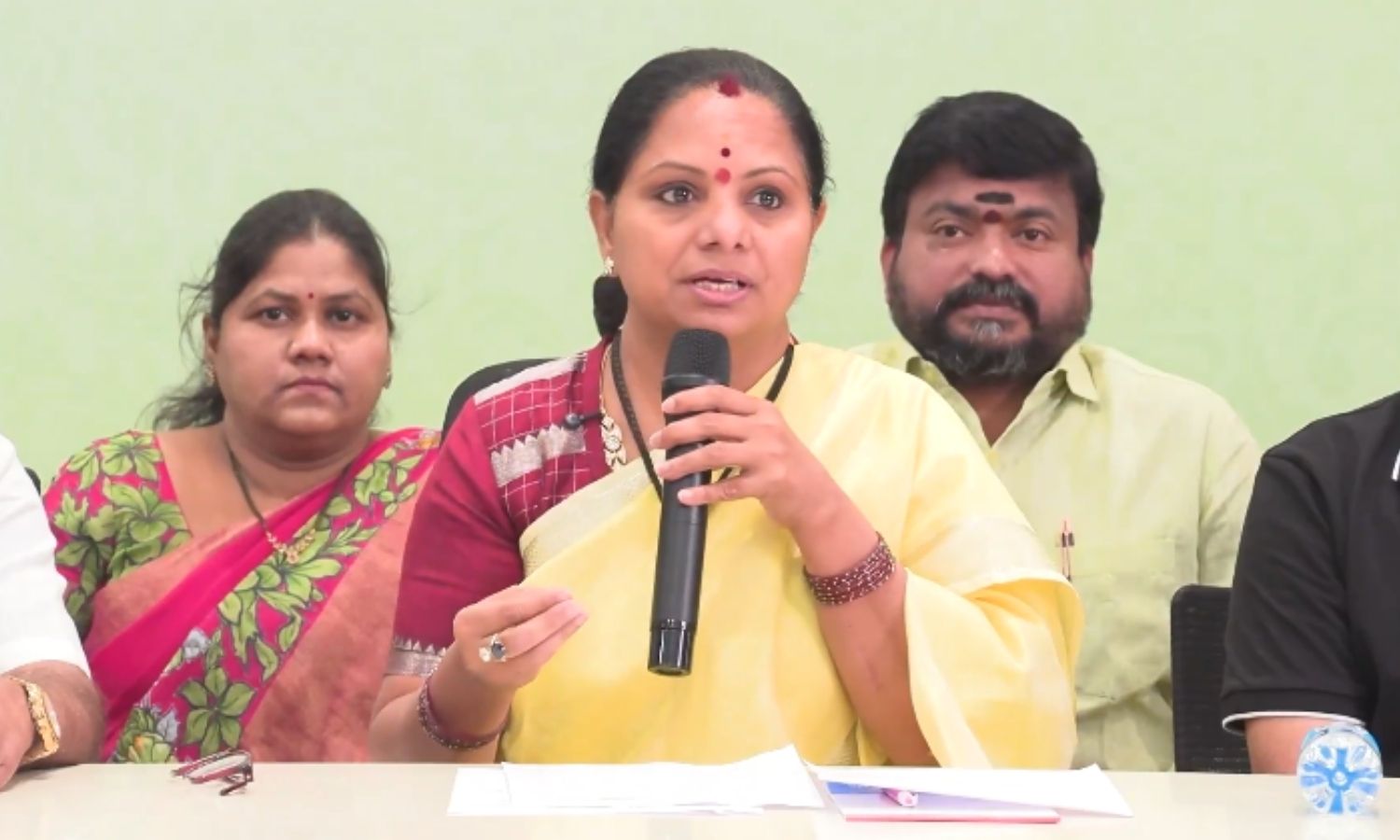
Hyderabad: Telangana Jagruthi president K. Kavitha demanded an immediate law to regulate private school fees after alleging that school managements had raised charges by 30% to 40% and pushed parents into distress.
Addressing the media at the Telangana Jagruthi office on Friday, she asked the government to convene a special session of the Assembly and pass fee control legislation without delay. She said the steep revisions had placed an unfair financial burden on families across the state. Moreover, she argued that the government could no longer postpone action on private school fees.
Kavitha said nearly 38 lakh students were studying in about 12,000 private schools in Telangana. She said the scale of enrolment made the issue urgent and statewide. According to her, private school fees had risen sharply even as household incomes had not increased at the same pace. Therefore, she said poor and middle-class families were struggling to absorb sudden hikes of up to 40%.
She said annual increases should have been capped at 7% to 8%. She argued that such a limit would have offered relief to parents while still allowing schools to revise charges within a reasonable range. However, she said many institutions had instead imposed steep increases in a single cycle.
Private school fees and demand for new law
Kavitha recalled that Chief Minister A. Revanth Reddy had earlier criticised the previous government for failing to regulate school charges. She said he had attacked that inaction while in opposition. Now, she asked why no law had been enacted after he assumed office.
She said more than two and a half years of Congress rule had passed without meaningful progress on fee regulation. She also criticised the report of the state Education Commission. While reviewing it, she said the document had fallen short on the larger crisis. Still, she said one recommendation stood out: the need for a legal framework to regulate fees in private schools and junior colleges.
Kavitha said the government should have treated that recommendation as the starting point for legislation. Instead, she suggested, the administration had allowed the issue to drift. As a result, parents had continued to face repeated demands from private institutions at the start of each academic cycle.
She warned that any government that tolerated fee exploitation could face the same political backlash that hurt the previous administration. She said families were watching closely and would judge the ruling party on whether it intervened. Further, she said the state could not ignore public anger over private school fees for long.
Private school fees and jobs, staff pay
Kavitha also raised concerns over employment practices in corporate and non-local private schools. She alleged that many such institutions had failed to provide jobs to youth from Telangana. In her view, schools operating in the state should have created more opportunities for local candidates.
She said the problem extended beyond what parents paid. Despite collecting substantial fees, many schools had not offered fair salary hikes or adequate benefits to teachers and other staff, she alleged. She suggested that the burden had fallen unevenly, with parents paying more while employees saw little improvement in wages or service conditions.
Kavitha said the issue involved both affordability and accountability. She argued that the state had to protect parents from steep charges and ensure that education institutions followed fair employment and compensation practices. Meanwhile, she repeated her demand for a fee regulation law and a special Assembly session to pass it.
Her remarks placed fee regulation back at the centre of the education debate in Telangana. They also sharpened pressure on the government to explain why a legal mechanism on private school fees had still not been introduced despite repeated public complaints and earlier political promises.