

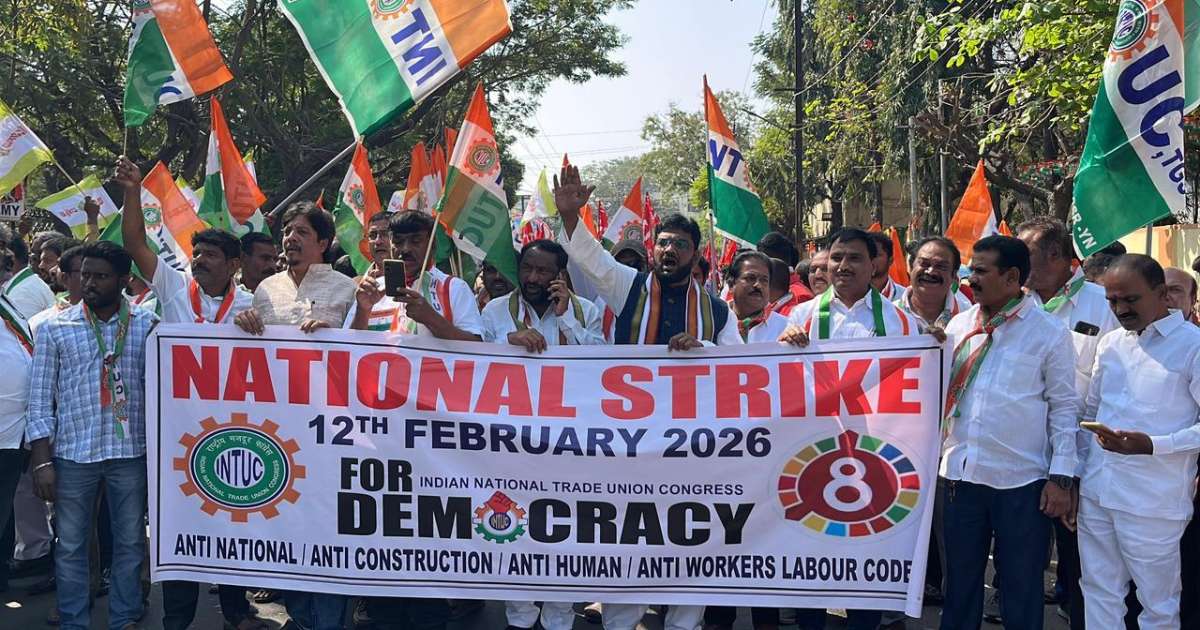
Hyderabad: The Hyderabad District Congress Committee (DCC) demanded Labour Codes repeal or major amendments during a public meeting at Dharna Chowk following the Bharat Bandh rally on Thursday.
Hyderabad DCC president Syed Khalid Saifullah said the party sought restoration of the 100-worker threshold for retrenchment protection and withdrawal of restrictions on the right to strike. He addressed the gathering after the rally concluded at Indira Park.
The bandh was observed following a call by a joint platform of ten central trade unions and farmers’ organisations. The rally began at the VST Union Office opposite RTC Kalyana Mandapam in Baghlingampally. It passed through Musheerabad before ending at Indira Park, where leaders held a meeting.
B Mahesh Kumar Goud, Anil Kumar Yadav and Motha Rohit Mudiraj were among senior leaders who joined the rally and addressed workers.
Labour Codes repeal and retrenchment threshold concerns
In his speech, Saifullah said the four Labour Codes the Code on Wages (2019), Industrial Relations Code (2020), Code on Social Security (2020) and Occupational Safety Code (2020) — replaced 29 existing labour laws. He stated that the changes were introduced without adequate consultation with trade unions. According to him, the new framework restructured the relationship between workers, employers and the state.
He noted that earlier, firms employing 100 or more workers required government approval before retrenchment. However, the threshold had been raised to 300 workers under the new provisions. As a result, he said lakhs of workers in mid-sized firms were left without retrenchment protection.
He also pointed out that the requirement for standing orders had increased from 100 to 300 workers. Consequently, he argued, formal workplace governance had been reduced in smaller establishments.
Labour Codes repeal and strike restrictions
Referring to the right to strike, Saifullah said strike notices were previously mandatory only in public utility services. Under the new rules, he said, a 60-day notice was required in all sectors. Moreover, strikes were barred during conciliation proceedings. He stated that these provisions curtailed organised labour’s negotiating power.
He criticised the expansion of fixed-term employment across industries. According to him, permanent jobs were being replaced by short-term contracts, increasing employment insecurity.
Highlighting the joint participation of workers and farmers, he said the protest reflected wider concerns about reduced protections and institutional support. He added that nearly 90 per cent of India’s workforce was informal. Therefore, weakening safeguards in the formal sector would further informalise employment.
Saifullah also questioned claims that labour flexibility would boost job creation. He said formal job growth had not accelerated. In addition, he stated that real wages for lower-income groups remained stagnant.
The DCC president reiterated the demand for tripartite consultation before implementing any labour reforms. He also called for universal social security coverage for informal and gig workers. Further, he sought legislative backing for minimum support price and assured market access for farmers. Finally, he urged Congress workers to continue peaceful mobilisation in defence of labour and farmers’ rights.