

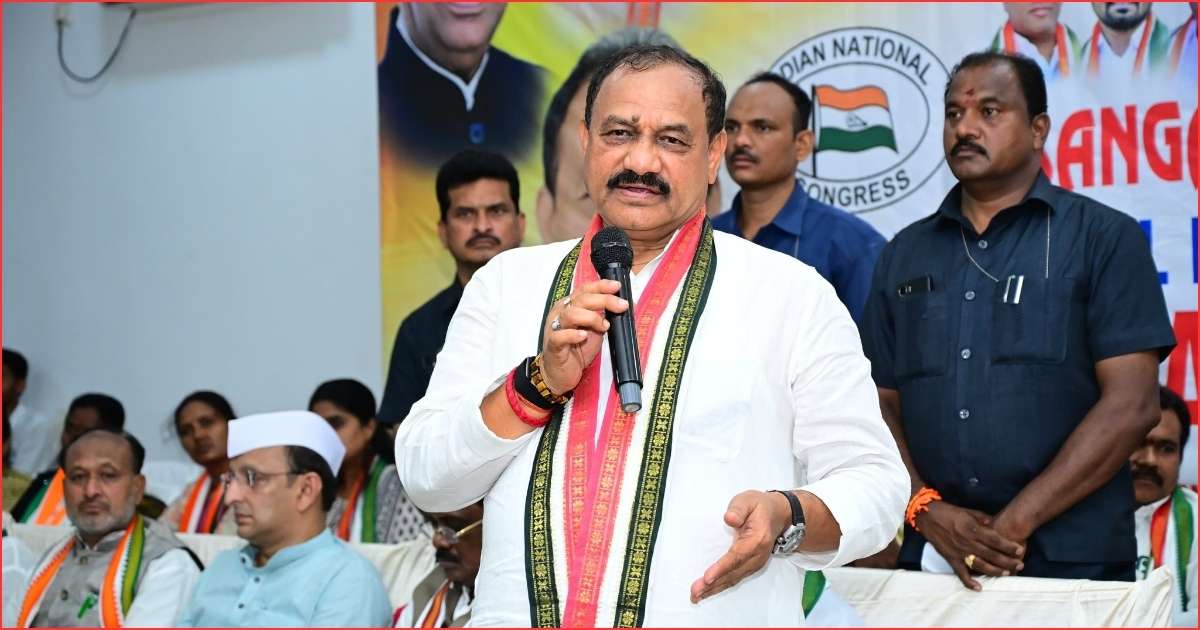
Hyderabad: TPCC president Mahesh Kumar Goud said the BRS lost relevance in Telangana, citing internal divisions and declining political strength within the opposition party.
Addressing mediapersons at Gandhi Bhavan on Friday, he launched a sharp attack on opposition parties. He said the BRS lost relevance due to internal rifts and weakening leadership. Moreover, he claimed the Bharatiya Janata Party had failed to establish a foothold in the state.
Goud pointed to tensions within the family of K. Chandrashekar Rao. He alleged a power struggle between K.T. Rama Rao and T. Harish Rao. At the same time, he said KCR had withdrawn from active politics. According to him, these developments had weakened the party structure and contributed to the perception that the BRS lost relevance.
He also referred to former MP K. Kavitha, stating that she was charting an independent course. As a result, he said the party faced a precarious and desperate situation. He argued that such internal issues had further reinforced the view that the BRS lost relevance in Telangana politics.
BRS lost relevance amid opposition weakness claims
Goud dismissed the BJP as a significant force in Telangana. He said the party lacked grassroots presence and organisational strength. Therefore, he argued, it could not pose a serious challenge to the ruling Congress.
He added that regardless of opposition strategies, public support remained firmly with the Congress. He said recent election results reflected this trust among voters. In his view, the mandate had strengthened the Congress position in the state.
Goud expressed confidence that the Congress would secure a decisive victory if elections were held now. He said the party could win up to 100 seats. He attributed this confidence to what he described as strong governance and continued public backing.
He maintained that the political landscape in Telangana had shifted significantly. According to him, internal discord within opposition parties had reshaped voter perceptions. As a result, he reiterated that the BRS lost relevance and the Congress remained dominant in the state.