

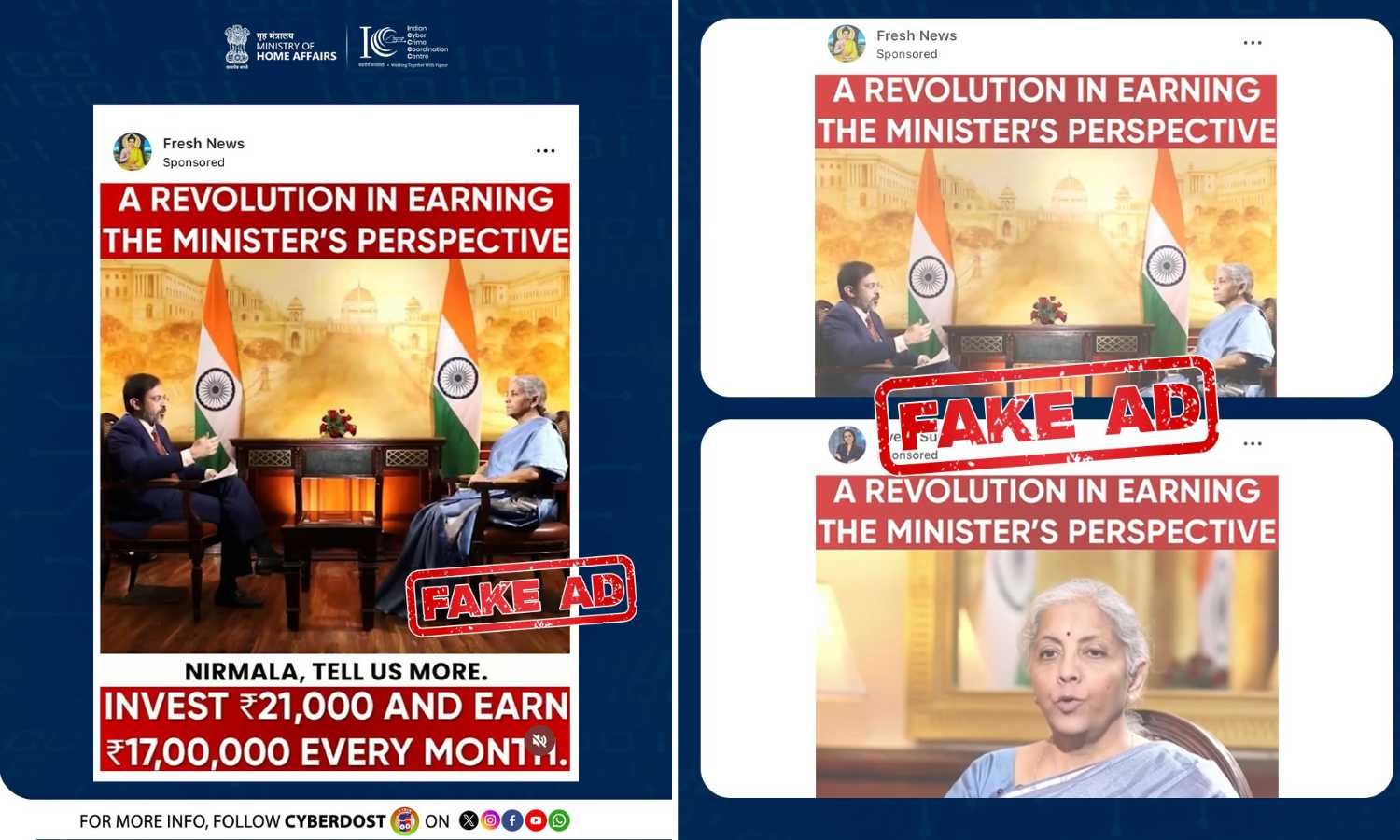
Hyderabad: A government employee from Ramanthapur lost ₹3.2 lakh after falling prey to a sophisticated online scam involving a deepfake video of Finance Minister Nirmala Sitharaman.
The fraudsters used artificial intelligence to create a highly convincing fake video showing the Union Finance Minister promoting a one-time investment scheme. In the doctored clip, she appeared to claim that investing ₹21,000 would yield returns running into lakhs every month. The video, circulated widely on Facebook, caught the attention of the unsuspecting victim.
After watching the video in March, the employee clicked on the provided link and filled out an online form. Within days, someone claiming to be an investment agent called him, confirming that his application had been received. He was then instructed to download an app called ‘Findexa’ to manage his new investment portfolio.
Soon after, a woman who identified herself as Sneha Reddy called and persuaded him to deposit ₹21,675, claiming he would start earning profits from day one. Believing her, he made the transfer. True to her word, or so it seemed, the app reflected a profit of ₹1,265 the very next day, which he was even allowed to withdraw, cementing his trust in the scheme.
Over the next few days, as he repeatedly opened the app, he saw his returns growing steadily, displayed in dollars. But whenever he tried to withdraw larger sums, the app either blocked the transaction or blamed technical issues.
After a short break, the fraudsters called back, this time urging him to put in a larger sum. They promised that by investing more, he’d unlock “massive weekly profits” through something they called “gap trading.” Hooked by the prospect of easy returns, he deposited another ₹3 lakh.
They sweetened the pitch by claiming withdrawals could only happen once a week, on Wednesdays. Deposits were made in rupees, but the app displayed his supposed profits in dollars, which made the whole setup seem even more lucrative.
A week later, the app showed that ₹29,505 had been credited to his account and was ready to withdraw. It even marked the withdrawal as “processed” and claimed the funds had been transferred to his bank. But when he checked his account, nothing had come through. On contacting the app’s customer service, he was told it might be a technical issue and was urged to invest more, with promises of assigning a new agent to assist him.
By this time, doubts crept in. The employee approached his bank, where officials confirmed he had fallen victim to a scam. He immediately reported the matter to the national cybercrime helpline (1930) and filed a formal complaint at the Rachakonda Cybercrime Police Station.
Cybercrime officials warn that fraudsters are increasingly exploiting AI technology to fabricate videos featuring prominent personalities, luring innocent people into such traps. Police have cautioned the public against believing such videos and warned that these scams are becoming increasingly sophisticated.
The case is now under investigation.